By Jason Polonski, REALTOR® with Right at Home Realty · 15+ years in Ottawa real estate · Last updated: November 2026
Old Ottawa South is a small, walkable central Ottawa neighbourhood that sits between the Rideau Canal and the Rideau River, just south of the Glebe across the Bank Street bridge. It is known for early 1900s brick homes on tree-lined streets, a village-style stretch of Bank Street, two riverside parks and an easy walk or cycle to Lansdowne, Carleton University and downtown.
Buyers here are usually choosing a lifestyle as much as a house: walking to school, coffee and the canal, and living in an older home with character. This guide covers where Old Ottawa South is, what the homes are like, schools, parks, transit, and what Jason Polonski looks for when helping clients buy and sell here. For a wider view of central communities, see the Ottawa neighbourhoods guide, or go straight to Old Ottawa South homes for sale.

Where Is Old Ottawa South?
Old Ottawa South is in Capital Ward, in the heart of the city. It is bounded roughly by the Rideau Canal to the north, the Rideau River to the south and east, and Bronson Avenue and Carleton University to the west. Avenue Road marks the eastern edge, where it meets Old Ottawa East.
The neighbourhood is compact. Most homes are within a few minutes’ walk of Bank Street, and almost every street ends at water or a park. That geography is a big part of its appeal: there is very little through traffic, and the canal and river frame the community on three sides.
The area was known simply as “Ottawa South” for most of its history. The “Old” was added in the 1990s to distinguish it from the newer suburbs that grew up in the south end of the city.
A Short History of Old Ottawa South
Settlers built homes along the north shore of the Rideau River, in what is now Windsor Park, as early as the 1810s, making this one of the oldest settled areas in Ottawa. A small village with a mill, church and school grew slowly over the following decades.
The real change came with the streetcar. Once the line reached the area in the early 1900s, the farmland and estates were subdivided and the streets filled with the brick homes you see today. Hopewell Avenue Public School opened in 1910, and the old streetcar route roughly followed today’s bus route, turning around in what is now Brewer Park.
Many of the neighbourhood’s institutions date from that period: Southminster United Church at Bank Street and Aylmer Avenue, the former Precious Blood convent (now home to the Royal College of Physicians and Surgeons of Canada), and the old firehall on Sunnyside Avenue, which is now the community centre.
What Homes Can You Buy in Old Ottawa South?
Old Ottawa South is mostly a neighbourhood of houses, not condos. Expect:
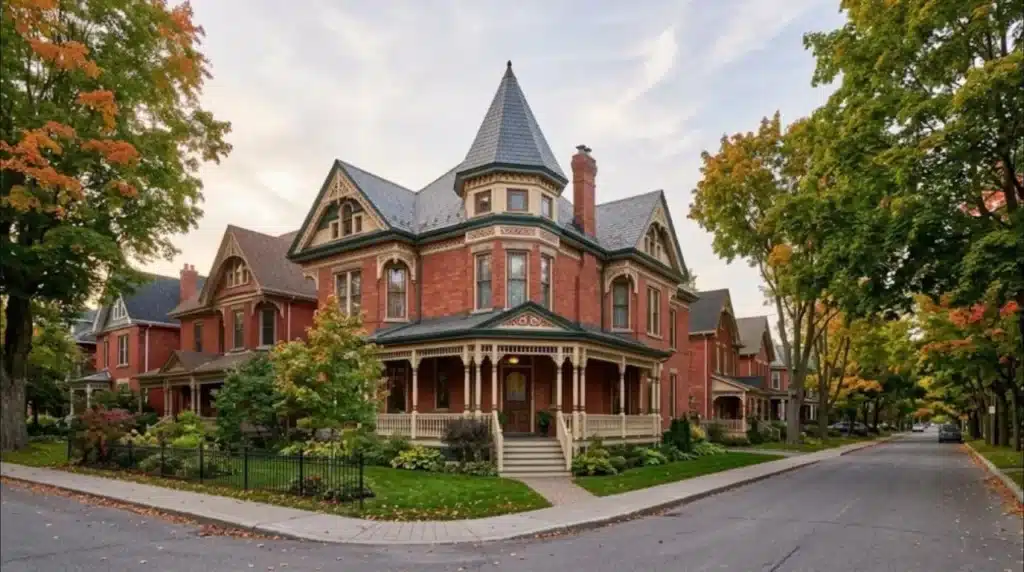
- Early 1900s detached and semi-detached brick homes, often two and a half storeys, with front porches, original woodwork and narrow, deep lots.
- Postwar homes and smaller detached houses, particularly toward the river and in the Rideau Gardens pocket shared with Old Ottawa East.
- Modern infill, including semi-detached and detached homes built where older houses have been replaced.
- A small number of low-rise condos and converted buildings, mainly near Bank Street.
Because most of the housing stock is a century old, condition varies widely from one house to the next. Two homes of the same size on the same street can sell far apart depending on wiring, plumbing, foundation and how well past renovations were done. That is why Jason prices homes here street by street from recent comparable sales, not from area-wide averages.
What to check in an older Old Ottawa South home
Jason’s background in construction and the electrical trades shapes how he walks through older homes with clients. In Old Ottawa South, the common items to look at before you firm up an offer are:
- Wiring. Some homes of this era still have knob-and-tube or partially updated wiring, which can affect insurance and financing. The Electrical Safety Authority explains what to look for.
- Water service. Older homes may still have a lead water service line between the street and the house. The City of Ottawa’s lead pipe replacement program explains how to check and what help is available.
- Foundations and basements. Stone and early concrete foundations need good drainage. Look for signs of water and ask about past repairs.
- Radon. Radon can be present in any Ottawa home. Health Canada recommends testing, which is simple and inexpensive.
For a deeper checklist, read Jason’s guide to buying an older home in Ottawa and what to ask in a home inspection.
Sell Your Ottawa Home for Just 1% Listing Commission
Why pay 2.5% listing commission to sell your home when you don't have to? Jason Polonski lists Ottawa homes for a simple 1% listing commission. Full MLS® and REALTOR.ca exposure, professional photography, powerful online marketing, expert pricing, and a skilled negotiator fighting for every dollar of your sale price. Top-tier service — you just keep thousands more when your home sells. Smart sellers are already making the switch. Your home deserves the best, and your wallet deserves a break.
Living in Old Ottawa South
Bank Street
The stretch of Bank Street south of the canal is the neighbourhood’s main street. It has independent cafés, restaurants, bakeries and shops, plus the Mayfair Theatre, one of Ottawa’s oldest independent cinemas. Most residents do their daily errands on foot.
Across the Bank Street bridge, Lansdowne offers TD Place, restaurants, shops and the farmers’ market. Billings Bridge Shopping Centre, a few minutes to the south-east, covers larger errands.
Parks, the canal and the river
Few central neighbourhoods have this much green space. Brewer Park has a pond, splash pad, sports fields, an arena and a public pool. Windsor Park runs along the Rideau River with a popular sledding hill. The Rideau Canal, a UNESCO World Heritage Site, forms the northern edge, with pathways and, in winter, the Skateway.
The Ottawa Tennis and Lawn Bowling Club is also in the neighbourhood, and the riverside pathways link to the wider National Capital Commission pathway network.
Community life
The Old Ottawa South Community Association runs programs from the Firehall community centre at 260 Sunnyside Avenue, and the community publishes its own newspaper, The OSCAR. Street parties, the Hopewell book and bike sales and other volunteer-run events give the area a small-town feel. You can follow local news and events through the Old Ottawa South Community Association.
The Sunnyside branch of the Ottawa Public Library is on Bank Street.
Get Cash Back When You Buy a Home in Ottawa
Can you get cash back when buying a home in Ottawa? Yes. Jason Polonski, a Chairman's Club REALTOR® serving Ottawa and Kanata, shares part of his commission with buyers — up to $3,000 cash back at closing.* You still get full-service, award-winning representation: expert pricing, sharp negotiation, and hands-on guidance from first showing to keys in hand. No cut corners and no rebate-only shortcuts — just real money back in your pocket when you buy your Ottawa or Kanata home.
Schools in Old Ottawa South
Hopewell Avenue Public School, on Hopewell Avenue, is the neighbourhood’s English public elementary school, teaching junior kindergarten to Grade 8 with English and French immersion programs. For high school, English public students typically attend Glebe Collegiate Institute, across the canal. Immaculata High School, the nearest English Catholic high school, is in neighbouring Old Ottawa East.
Catchments change, and program availability differs by grade. Always confirm the address with the OCDSB school locator or the Ottawa Catholic School Board before you buy. Families comparing options can also read Jason’s overview of Ottawa schools.
Getting Around Old Ottawa South
Old Ottawa South is one of the easiest central neighbourhoods to live in without driving every day.
- O-Train Line 2. Carleton station, at Carleton University on the western edge of the neighbourhood, connects north to Bayview and Line 1, and south to South Keys and Riverside South, with a transfer to Line 4 for the airport. See OC Transpo for routes and schedules.
- Buses. Frequent routes run along Bank Street to the Glebe, Centretown and downtown, and south to Billings Bridge and South Keys.
- Cycling and walking. The canal and river pathways make cycling downtown, to Lansdowne or to the University of Ottawa straightforward for much of the year.
- Driving. Bronson Avenue, Riverside Drive and Bank Street connect to the Queensway and the Airport Parkway.
For commute planning across the city, see Jason’s guide to commuting in Ottawa and homes near O-Train stations.
Who Is Old Ottawa South Best For?
- Families who want a walkable school, parks and a strong community without moving to the suburbs.
- Professionals and academics working downtown, at Carleton University or at the hospitals, who value a short commute.
- Move-up buyers leaving a condo or townhouse for a detached home with character in the centre of the city.
- Downsizers who want to stay central and walkable, often moving from a larger home in the same part of town.
It is less suited to buyers who need a large lot, a double garage or brand-new construction at a lower price point. For those priorities, the best suburbs in Ottawa are a better starting point.
Old Ottawa South vs. The Glebe
The two neighbourhoods are often compared because they share the canal, Bank Street and Lansdowne. The Glebe is larger, busier and has more shops and restaurants. Old Ottawa South is smaller and quieter, with more of a village feel and more green space per resident thanks to Brewer and Windsor parks.
Housing is similar in age and style. Buyers who like the Glebe but want a slightly calmer street often look at both. Read the Glebe neighbourhood guide to compare.
Buying and Selling in Old Ottawa South
Turnover is low here. Many owners stay for decades, and good homes on the best streets do not come up often. That makes preparation important on both sides of a deal.
This is where a local agent earns their fee. Jason Polonski follows Old Ottawa South sales street by street, so his buyers can move quickly when the right home lists and his sellers price from the most relevant comparables. Buyers working with Jason can receive up to $3,000 cash back at closing on qualifying purchases, and sellers can list with his 1% Listing Commission.
If you are buying, get pre-approved before you start, know which streets and school catchments matter to you, and be ready to act when the right home comes up. Ask for the seller’s records on wiring, plumbing and roof work, and do not skip the inspection on an older home. Jason’s first-time buyer tips for Ottawa cover the basics.
If you are selling, pricing an older home correctly depends on its condition and updates as much as its size. Documented upgrades to wiring, plumbing and the roof support your price. A comparative market analysis based on recent nearby sales is the right starting point, and you can find out what your home is worth before you decide.
If you are doing both, timing is the biggest risk. Jason’s guide to selling and buying a home at the same time explains how to avoid carrying two homes or having nowhere to go.
For board-wide trends, the Ottawa Real Estate Board publishes monthly statistics, and Jason summarizes them in his Ottawa real estate market update.
Nearby Neighbourhoods to Compare
- The Glebe, across the canal, with more shops and a larger housing stock.
- Old Ottawa East, next door along the Rideau River, with Main Street and newer homes in Greystone Village.
- Alta Vista, south-east across the river, with larger lots and mid-century homes.


Posted on Google 

Jennifer Clark
3 days ago
 Trustindex verifies that the original source of the review is Google.
His availability to communicate was incredible which is so important when selling a house. Great at everything else too.
Posted on Google

Aarushi Govil
14 days ago
Trustindex verifies that the original source of the review is Google. Working with Jason has been an absolute privilege from start to finish. Finding the right realtor can be daunting, but Jason exceeded every expectation. He is remarkably knowledgeable and was extremely punctual and responsive to every question or request we had, no matter the time or the day. What stood out most was his complete sincerity and zero-pressure approach. When we walked through houses, he was transparent, pointing out both the pros and potential red flags instead of trying to make a quick sale. His honest feedback gave us complete confidence in our decision. If you want a dedicated, honest, and highly skilled agent in your corner, look no further than Jason!
Posted on Google

Joe Ireland
28 days ago
Trustindex verifies that the original source of the review is Google. Jason helped me buy my first home.
He was extremely responsive and available from our very first call, and assisted with booking multiple viewings across Ottawa.
He was punctual to every viewing and honest with his feedback with the homes we saw, and when it came time to go from viewing to buying, he had an impressive array of contacts from brokers to inspectors to lawyers, all with excellent reviews and who were great to work with in their own right.
As a first-time home buyer, his responsiveness and patience with many questions were extremely reassuring and really streamlined the process, and I signed an offer on my home within just 2 weeks of meeting him.
I would strongly recommend Jason to anyone buying a home in Ottawa, especially to those who are strangers to the process like I was.
Thank you again, Jason!
Posted on Google

Marina
58 days ago
Trustindex verifies that the original source of the review is Google. We had a wonderful experience working with our realtor - Jason Polonski. He is a professional, knowledgeable, responsive, and truly attentive to our needs. Jason guided us through every step of the process, answered all of our questions. My family are very grateful for his work and would absolutely recommend him to anyone looking for a reliable and trustworthy realtor in Ottawa and around !
Posted on Google

Vatrul “Vatrul”
62 days ago
Trustindex verifies that the original source of the review is Google. First time home seller. Every process of the journey was explained and laid out perfectly.. Very highly recommended.. thank you Jason..
Posted on Google

Olga V.
63 days ago
Trustindex verifies that the original source of the review is Google. Jason is very knowledgeable realtor in Kanata. He’s been always good beyond to help his clients. We had a place experience buying a house in Kanata. I highly recommend him.
Posted on Google

Yuri Tsouker
70 days ago
Trustindex verifies that the original source of the review is Google. Working with Jason on the sale of my property was genuinely one of the smoothest professional experiences I've had. He was responsive at every step, patient with every question (and I had many), and he clearly knew the local market inside and out.
My sale wasn't a simple one — there was a tenant, a rental water heater, a plumber to coordinate, and plenty of complications that made this a genuinely difficult case. Jason handled all of it with calm, practical advice and always got back to me quickly, often with a solution before I even finished asking about the problem.
What stood out most was his honesty. He didn't push, he didn't overpromise, and every recommendation he made turned out to be exactly right. I felt like I had a professional in my corner from day one.
If you're looking for a realtor who is knowledgeable, responsive, and genuinely trustworthy, I can't recommend Jason highly enough. Thank you, Jason — much appreciated!
Posted on Google

Denis Pepin
94 days ago
Trustindex verifies that the original source of the review is Google. Outstanding Experience with Jason Polonski!
Last May, my wife and I sold our home in Stittsville with Jason Polonski, and we couldn't be happier with our decision. Jason made the entire process remarkably smooth and stress-free.
From day one, Jason stood out for his exceptional communication. He was always prompt and available to answer our queries—often within minutes—no matter the time of day. Whenever we had questions regarding paperwork, listing strategies, or handling property details, he addressed every concern with a truly genuine, human touch.
What impressed us most was how proactive and reassuring he was at every step. When we had to coordinate the buyout of our water heater rental, Jason handled the reimbursement seamlessly, reassuring us with, "We should have a smooth sale now. :)"—and it truly was! Even post-closing, when we needed to arrange delivery for mailbox keys or track down final funds from head office, Jason stayed on top of every detail, putting a rush on things and constantly keeping us updated.
Jason is a dedicated, attentive, and highly professional realtor who genuinely cares about his clients. It has been an absolute pleasure working with him, and we highly recommend Jason Polonski to anyone looking to buy or sell a home in the Ottawa region.
Posted on Google

Tammy Puhakka
103 days ago
Trustindex verifies that the original source of the review is Google. I highly recommend Jason Polonski, a realtor in Kanata, Ottawa. He truly went above and beyond for me. During a long weekend, he called me and, within just two hours, had an offer to purchase prepared and sent so I could secure the home I had found and fallen in love with.
Jason was professional, efficient, knowledgeable, and incredibly pleasant to work with. His rates are very reasonable, and his dedication to his clients is outstanding. If you’re looking for fast, reliable, and friendly service, I would absolutely recommend contacting him.❤️
Posted on Google

Joe Melindy
108 days ago
Trustindex verifies that the original source of the review is Google. Everything went smoothly. Jason is very good at what he does. Would highly recommend. Thanks Jason 😊
Work With a REALTOR® Who Reads Older Homes
Jason Polonski is a REALTOR® with Right at Home Realty who has helped hundreds of buyers and sellers across Ottawa over more than 15 years. Before real estate, he worked in construction and the electrical trades and earned a technical diploma in construction electricity, so he walks through century homes with a builder’s eye: he notices the wiring, the foundation and the quality of past renovations that affect what a house is worth.
He also holds a Bachelor of Commerce from Concordia University with a double major in Marketing and Finance, which shapes how he prices, markets and negotiates. Whether you are buying your first home in Old Ottawa South or selling a family home you have owned for decades, Jason’s job is to help you avoid a timing mistake first, then get the best price. Read client reviews, see his Google Business Profile, or call or text (613) 601-9333.
Old Ottawa South FAQs
Old Ottawa South is in central Ottawa, between the Rideau Canal to the north and the Rideau River to the south and east, with Bronson Avenue and Carleton University to the west. It is just south of the Glebe across the Bank Street bridge.
For buyers who want walkability, older homes with character and lots of green space close to downtown, yes. It has a strong community, its own main street on Bank Street, and Brewer and Windsor parks. Trade-offs include older homes that may need updates and limited parking on some streets.
Mostly early 1900s detached and semi-detached brick homes, along with postwar houses, modern infill and a small number of condos near Bank Street.
Hopewell Avenue Public School (JK to Grade 8) is the local English public elementary school, and Glebe Collegiate Institute is the usual English public high school. Immaculata High School in Old Ottawa East is the nearest English Catholic high school. Confirm catchments with the school board before buying.
Yes. Carleton station on O-Train Line 2 is at Carleton University, on the western edge of the neighbourhood. Bus routes on Bank Street also connect to downtown.
They are neighbours separated by Avenue Road. Old Ottawa South centres on Bank Street and Brewer Park, while Old Ottawa East centres on Main Street, Saint Paul University and the newer Greystone Village development.
