Ottawa Home Sellers
MPAC Assessed Value vs Market Value
By Jason Polonski, REALTOR® with Right at Home Realty · 15+ years in Ottawa real estate · Updated October 2026 · Client reviews
MPAC Assessed Value vs Market Value in Ontario
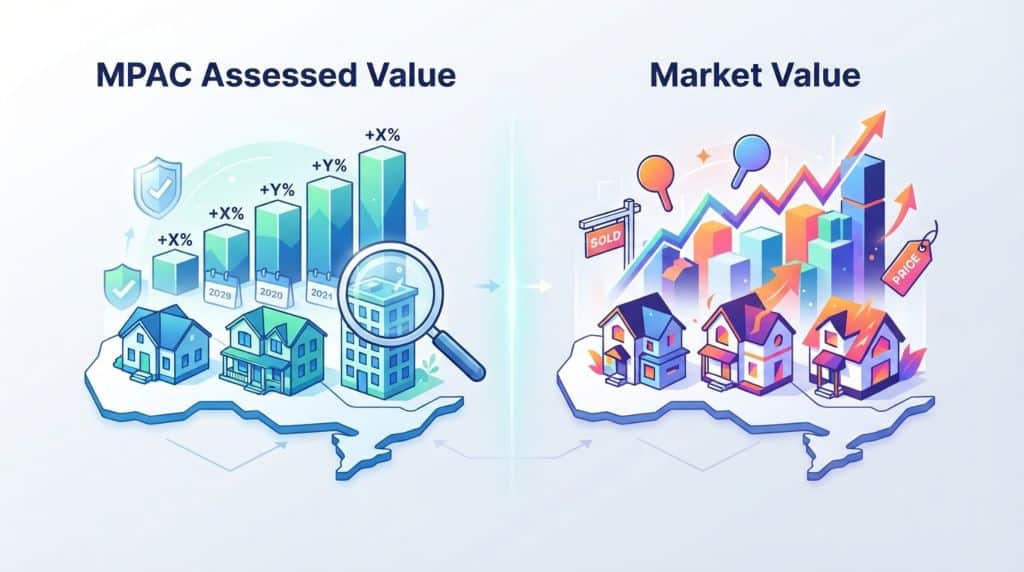
Your MPAC assessed value is the value the Municipal Property Assessment Corporation assigns to your home for property-tax purposes — and it is not the same as market value, which is what your home would actually sell for today. The two often differ by a wide margin, especially now, because Ontario’s assessments are still based on a January 1, 2016 valuation date. If you’re pricing your home to sell, the MPAC number is one of the least reliable figures you could use. Here’s why they differ and what to rely on instead.
What is MPAC and the assessed value?
The Municipal Property Assessment Corporation (MPAC) is the independent body that assesses the value of every property in Ontario for property-tax purposes. Your municipality uses MPAC’s assessed value to apportion property taxes among homeowners — it’s a tax tool, not a selling tool.
Crucially, MPAC uses mass appraisal: it values properties in bulk using models and property characteristics as of a set valuation date, rather than individually inspecting and pricing each home for today’s market. That approach is efficient and fair for distributing taxes, but it produces a number that can be quite different from what your specific home would fetch on the open market right now.
What is market value?
Market value is what a willing buyer will actually pay a willing seller in the open market today — the real selling price, set by current supply, demand, competition, condition, and buyer emotion. It changes with the market and reflects your home’s specific features and today’s conditions, unlike a mass-appraised, date-frozen assessment. Local demand tracked by the Ottawa Real Estate Board and national context from the Canadian Real Estate Association shape it.
Market value is what matters when you sell, and it’s discovered by exposing the home to the market, informed beforehand by a comparative market analysis. It’s a live number; the MPAC assessment is a historical one.
Why they’re different
Three fundamental differences drive the gap. Purpose: MPAC values are for taxation; market value is for selling. Method: MPAC uses mass appraisal across many properties; market value reflects your individual home and real buyer demand. Timing: MPAC assessments are tied to a past valuation date, while market value is current. Because of this, the two numbers are measuring different things for different reasons — so it’s normal for them to diverge, sometimes dramatically.
An assessed value can be well below market value (common, given the dated valuation) or occasionally above it for a particular property. Either way, the assessment tells you how your taxes are apportioned, not what your home is worth to a buyer. Think of them as two separate scorecards kept for two separate games: one decides your share of the municipal tax bill, the other decides what you’ll actually receive at closing. Confusing the two is where sellers go wrong.
Sell Your Ottawa Home for Just 1% Listing Commission
Why pay 2.5% listing commission to sell your home when you don't have to? Jason Polonski lists Ottawa homes for a simple 1% listing commission. Full MLS® and REALTOR.ca exposure, professional photography, powerful online marketing, expert pricing, and a skilled negotiator fighting for every dollar of your sale price. Top-tier service — you just keep thousands more when your home sells. Smart sellers are already making the switch. Your home deserves the best, and your wallet deserves a break.
The valuation-date lag
This is the big one right now. Ontario’s property assessments are still based on a January 1, 2016 valuation date — the province’s scheduled reassessments have been repeatedly postponed, so current assessment notices continue to reflect 2016 values rather than today’s. Given how much Ottawa home values have changed since 2016, the gap between a home’s assessed value and its current market value is often very large.
That means using your MPAC assessment to gauge today’s market value is especially misleading at the moment. Confirm the current assessment cycle status directly with MPAC and the Government of Ontario, since the reassessment timeline can change — but as things stand, the assessed value reflects a market that’s years out of date.
Assessment vs your property taxes
It helps to understand how the assessment is actually used. Your municipality — for most readers, the City of Ottawa — sets a tax rate and applies it to your assessed value to determine your property-tax bill. Because assessments are frozen at 2016 values province-wide, the relative assessments among homes are what apportion taxes, not the absolute dollar figure versus today’s prices.
So a rising market doesn’t automatically raise your assessment (it’s frozen), and your assessed value climbing or falling in a future reassessment doesn’t necessarily mean your taxes rise or fall by the same amount — it depends on how your home’s assessment changes relative to others. The assessment is a tax-apportionment number, full stop.
To see how far Ottawa values have moved since the 2016 valuation date, look at Ottawa house prices history.
Get Cash Back When You Buy a Home in Ottawa
Can you get cash back when buying a home in Ottawa? Yes. Jason Polonski, a Chairman's Club REALTOR® serving Ottawa and Kanata, shares part of his commission with buyers — up to $3,000 cash back at closing.* You still get full-service, award-winning representation: expert pricing, sharp negotiation, and hands-on guidance from first showing to keys in hand. No cut corners and no rebate-only shortcuts — just real money back in your pocket when you buy your Ottawa or Kanata home.
Why you shouldn’t price off your MPAC value
Given all of the above, pricing your home based on its MPAC assessment is a mistake in both directions. If your assessed value is well below market — likely, given the 2016 date — pricing to it would leave serious money on the table. If it happened to be above market for your property, pricing to it would overprice the home and cause it to sit. Either way, the assessment simply isn’t designed to tell you what buyers will pay today.
Buyers occasionally raise the MPAC number in negotiations (“but it’s only assessed at X”), so as a seller it helps to understand why that figure is irrelevant to current value — it’s a dated, tax-purpose, mass-appraised number, not a market appraisal. The risk of pricing on the wrong number is covered further in the guidance on why overpricing costs you.
Can you appeal your MPAC assessment?
Yes — if you believe your assessed value is inaccurate relative to comparable properties, MPAC has a process to review it, typically starting with a Request for Reconsideration and, if needed, an appeal to the Assessment Review Board. The details and deadlines are on the MPAC site, and it’s worth understanding that the goal of an appeal is fairness relative to similar homes, not aligning your assessment with today’s market value.
For a seller, an appeal is usually beside the point — you’re about to sell, and the assessment doesn’t set your sale price. Appeals matter more to long-term owners concerned that their taxes are unfairly high relative to neighbours. If you’re selling, the energy is better spent on a current market analysis than on the assessment. Still, it’s useful to know the mechanism exists, because buyers sometimes ask about it.

How the MPAC gap plays out in a sale
In practice, the assessment surfaces in a couple of ways during a sale, and it helps to be ready. A buyer or their agent may point to a low assessed value to argue the home is overpriced — the answer is that the assessment is a dated, tax-purpose figure, and recent comparable sales, not MPAC, set the current value. Occasionally a buyer worries a purchase well above the assessment means their taxes will jump; in a frozen-assessment environment, buying above the assessed value doesn’t automatically trigger a reassessment of that home to the sale price.
Being able to explain the assessment calmly and accurately keeps it from becoming a negotiating wedge. It’s one more reason to price on real market evidence and let the comparable sales — not a 2016-based number — carry the conversation about value.
What to use instead
To price your home, use current market evidence, not the assessment. A comparative market analysis (CMA) built from recent comparable Ottawa sales is the right tool — it reflects today’s market and your specific home. For a lender-grade valuation, a formal appraisal serves that purpose, and the difference between an appraisal and market value is its own topic. Both are grounded in current data; the MPAC assessment is not.
General guidance on home values from CMHC reinforces relying on current market evidence, and a registered agent prepares your CMA within the professional standards set by the Real Estate Council of Ontario. The bottom line: for taxes, MPAC; for selling, a CMA.


Posted on Google 

Jennifer Clark
13 days ago
 Trustindex verifies that the original source of the review is Google.
His availability to communicate was incredible which is so important when selling a house. Great at everything else too.
Posted on Google

Aarushi Govil
24 days ago
Trustindex verifies that the original source of the review is Google. Working with Jason has been an absolute privilege from start to finish. Finding the right realtor can be daunting, but Jason exceeded every expectation. He is remarkably knowledgeable and was extremely punctual and responsive to every question or request we had, no matter the time or the day. What stood out most was his complete sincerity and zero-pressure approach. When we walked through houses, he was transparent, pointing out both the pros and potential red flags instead of trying to make a quick sale. His honest feedback gave us complete confidence in our decision. If you want a dedicated, honest, and highly skilled agent in your corner, look no further than Jason!
Posted on Google

Joe Ireland
38 days ago
Trustindex verifies that the original source of the review is Google. Jason helped me buy my first home.
He was extremely responsive and available from our very first call, and assisted with booking multiple viewings across Ottawa.
He was punctual to every viewing and honest with his feedback with the homes we saw, and when it came time to go from viewing to buying, he had an impressive array of contacts from brokers to inspectors to lawyers, all with excellent reviews and who were great to work with in their own right.
As a first-time home buyer, his responsiveness and patience with many questions were extremely reassuring and really streamlined the process, and I signed an offer on my home within just 2 weeks of meeting him.
I would strongly recommend Jason to anyone buying a home in Ottawa, especially to those who are strangers to the process like I was.
Thank you again, Jason!
Posted on Google

Marina
68 days ago
Trustindex verifies that the original source of the review is Google. We had a wonderful experience working with our realtor - Jason Polonski. He is a professional, knowledgeable, responsive, and truly attentive to our needs. Jason guided us through every step of the process, answered all of our questions. My family are very grateful for his work and would absolutely recommend him to anyone looking for a reliable and trustworthy realtor in Ottawa and around !
Posted on Google

Vatrul “Vatrul”
72 days ago
Trustindex verifies that the original source of the review is Google. First time home seller. Every process of the journey was explained and laid out perfectly.. Very highly recommended.. thank you Jason..
Posted on Google

Olga V.
73 days ago
Trustindex verifies that the original source of the review is Google. Jason is very knowledgeable realtor in Kanata. He’s been always good beyond to help his clients. We had a place experience buying a house in Kanata. I highly recommend him.
Posted on Google

Yuri Tsouker
80 days ago
Trustindex verifies that the original source of the review is Google. Working with Jason on the sale of my property was genuinely one of the smoothest professional experiences I've had. He was responsive at every step, patient with every question (and I had many), and he clearly knew the local market inside and out.
My sale wasn't a simple one — there was a tenant, a rental water heater, a plumber to coordinate, and plenty of complications that made this a genuinely difficult case. Jason handled all of it with calm, practical advice and always got back to me quickly, often with a solution before I even finished asking about the problem.
What stood out most was his honesty. He didn't push, he didn't overpromise, and every recommendation he made turned out to be exactly right. I felt like I had a professional in my corner from day one.
If you're looking for a realtor who is knowledgeable, responsive, and genuinely trustworthy, I can't recommend Jason highly enough. Thank you, Jason — much appreciated!
Posted on Google

Denis Pepin
104 days ago
Trustindex verifies that the original source of the review is Google. Outstanding Experience with Jason Polonski!
Last May, my wife and I sold our home in Stittsville with Jason Polonski, and we couldn't be happier with our decision. Jason made the entire process remarkably smooth and stress-free.
From day one, Jason stood out for his exceptional communication. He was always prompt and available to answer our queries—often within minutes—no matter the time of day. Whenever we had questions regarding paperwork, listing strategies, or handling property details, he addressed every concern with a truly genuine, human touch.
What impressed us most was how proactive and reassuring he was at every step. When we had to coordinate the buyout of our water heater rental, Jason handled the reimbursement seamlessly, reassuring us with, "We should have a smooth sale now. :)"—and it truly was! Even post-closing, when we needed to arrange delivery for mailbox keys or track down final funds from head office, Jason stayed on top of every detail, putting a rush on things and constantly keeping us updated.
Jason is a dedicated, attentive, and highly professional realtor who genuinely cares about his clients. It has been an absolute pleasure working with him, and we highly recommend Jason Polonski to anyone looking to buy or sell a home in the Ottawa region.
Posted on Google

Tammy Puhakka
113 days ago
Trustindex verifies that the original source of the review is Google. I highly recommend Jason Polonski, a realtor in Kanata, Ottawa. He truly went above and beyond for me. During a long weekend, he called me and, within just two hours, had an offer to purchase prepared and sent so I could secure the home I had found and fallen in love with.
Jason was professional, efficient, knowledgeable, and incredibly pleasant to work with. His rates are very reasonable, and his dedication to his clients is outstanding. If you’re looking for fast, reliable, and friendly service, I would absolutely recommend contacting him.❤️
Posted on Google

Joe Melindy
118 days ago
Trustindex verifies that the original source of the review is Google. Everything went smoothly. Jason is very good at what he does. Would highly recommend. Thanks Jason 😊
Jason Polonski is a full-time Ottawa REALTOR® with Right at Home Realty who prices homes on current market evidence — not a dated tax assessment — seven days a week across Kanata, Stittsville, Barrhaven, Manotick, and the wider west end. His Bachelor of Commerce from Concordia University, a double major in Marketing and Finance, is the background that makes the distinction between assessed value, appraised value, and market value clear and practical, so his sellers price to what buyers will actually pay.
Working within the professional standards set by the Real Estate Council of Ontario and drawing on work with hundreds of Ottawa buyers and sellers, Jason makes sure the number you list at is the right one — and can explain to any buyer why the MPAC figure isn’t it. If you want to know what your home is truly worth today, a current market analysis is the place to start.
Related guides: what your home is worth · home appraisal vs market value · a comparative market analysis · what determines home value · about Jason Polonski · his Google reviews
MPAC Assessed Value vs Market Value (FAQs)
No. The MPAC assessed value is a mass-appraised figure for property-tax purposes, tied to a past valuation date. Market value is what your home would sell for today. They often differ by a wide margin and shouldn’t be used interchangeably.
Ontario assessments are still based on a January 1, 2016 valuation date — reassessments have been postponed — and MPAC uses bulk mass appraisal rather than pricing your specific home for today’s market. Both factors create a large gap with the current value.
No. It’s likely well below current market value given the 2016 date, so pricing to it would leave money on the table; if it were above market, it would overprice the home. Use a current comparative market analysis instead.
It’s used by your municipality to apportion property taxes among homeowners — the municipal tax rate is applied to your assessed value to set your tax bill. It’s a taxation tool, not a measure of what your home would sell for.
Not for pricing. The MPAC figure is a dated, tax-purpose, mass-appraised number, not a market appraisal, so it doesn’t reflect current value. Recent comparable sales, not the assessment, determine what your home is worth today.
A comparative market analysis based on recent comparable Ottawa sales, which reflects today’s market and your specific home. For a lender-grade figure, a formal appraisal serves that purpose. Both use current data, unlike the frozen MPAC assessment.
