Ottawa Home Sellers
Home Appraisal vs Market Value
By Jason Polonski, REALTOR® with Right at Home Realty · 15+ years in Ottawa real estate · Updated October 2026 · Client reviews
Before you act: Only a qualified appraiser can produce a formal appraisal, and lenders set their own requirements. Designations are issued by the Appraisal Institute of Canada.
Home Appraisal vs Market Value: What’s the Difference?
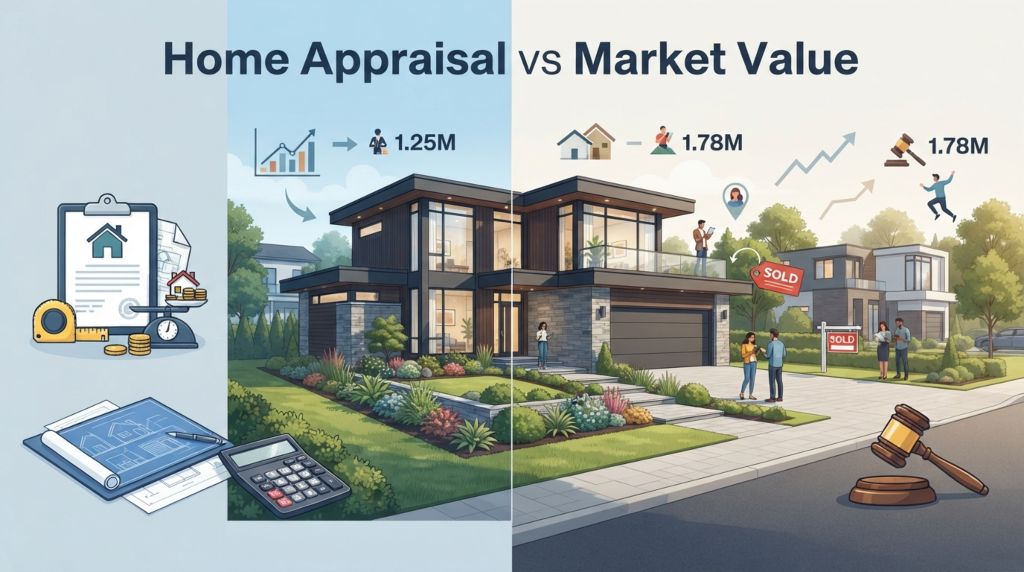
A home appraisal is a professional, lender-focused estimate of a property’s value at a specific point in time, used mainly to protect a mortgage lender; market value is what a buyer will actually pay for the home in the open market. They often differ — market value is driven by real-time buyer demand and emotion, while an appraisal is a more conservative, comparables-based valuation. Understanding the gap between the two matters a great deal when you sell, because it’s where financing can succeed or fall apart.
Here’s what each term means, why they diverge, and what it means for your Ottawa sale.
What is a home appraisal?
A home appraisal is a formal valuation performed by a qualified, licensed appraiser — a member of a body such as the Appraisal Institute of Canada — who assesses the property and estimates its value based largely on recent comparable sales, the home’s condition, size, location, and features. Appraisals are most often ordered by a buyer’s mortgage lender to confirm the home is worth what the buyer has agreed to pay before the lender advances the loan.
The appraiser’s job is to protect the lender, so appraisals tend to be conservative and grounded strictly in documented comparable sales. An appraisal is a professional opinion at a point in time — thorough and defensible, but not the same thing as what the open market will bear.
What is market value?
Market value is what a willing buyer will actually pay a willing seller in the open market — the real price a home commands given current demand. It’s set by the interplay of supply, demand, buyer emotion, competition, and timing. In a hot market with multiple buyers, market value can climb above what a comparables-based appraisal would show; in a slow market, it can sit below.
Market value is what you’re really after when you sell, because it’s the actual selling price. It’s discovered through exposure to the market — listing the home and seeing what buyers will pay — informed beforehand by a comparative market analysis. Local demand tracked by the Ottawa Real Estate Board and national context from the Canadian Real Estate Association shape it.
The key differences
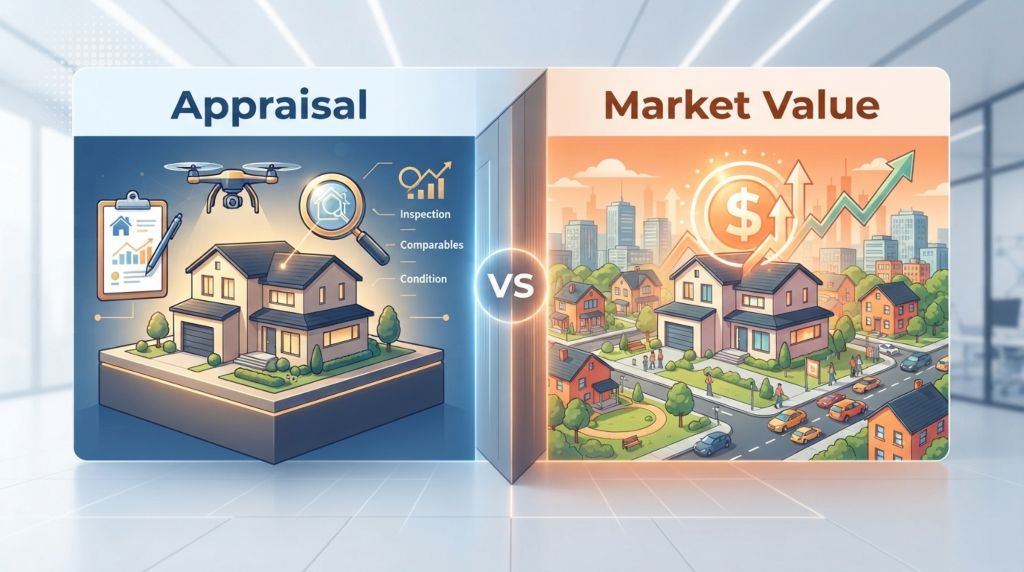
The core distinctions: an appraisal is a professional’s conservative estimate, primarily for a lender, based on documented comparables; market value is the actual price a buyer will pay, driven by real-time demand and emotion. An appraisal looks backward at closed sales; market value reflects what’s happening right now. An appraisal is one expert’s opinion; market value is the market’s verdict.
They frequently align, but not always — and the times they diverge are exactly when it matters most to a seller. That divergence is where deals can wobble. The simplest way to hold the two together in your mind: market value is what a home sells for, and an appraisal is a lender’s check that the price is reasonable enough to lend against. You want both working in your favour, which starts with pricing to what the market and the comparables jointly support.
Sell Your Ottawa Home for Just 1% Listing Commission
Why pay 2.5% listing commission to sell your home when you don't have to? Jason Polonski lists Ottawa homes for a 1% listing commission, charged on the final sale price; the buyer-side commission is separate. Full MLS® and REALTOR.ca exposure, professional photography, powerful online marketing, expert pricing, and a skilled negotiator fighting for every dollar of your sale price. Top-tier service — you just keep thousands more when your home sells. Smart sellers are already making the switch. Your home deserves the best, and your wallet deserves a break.
Why they can differ
Several things drive a gap. In a rising or hot market, competing buyers push prices above recent comparables, so market value outruns an appraisal that relies on older sales. For a unique or highly upgraded home, comparables are scarce, so an appraisal may not fully capture what a motivated buyer will pay. Timing matters too, since appraisals lean on past sales that may lag a fast-moving market. And buyer emotion — the willingness to stretch for a home they love — lifts market value in ways an appraisal doesn’t measure.
The result is that a home can genuinely sell for more than it appraises, or occasionally less. Neither number is “wrong”; they’re measuring different things.
When an appraisal matters in your sale
For a seller, the appraisal becomes critical after you’ve accepted an offer from a buyer who’s borrowing. The buyer’s lender orders an appraisal, and the mortgage is based on the appraised value, not the agreed price. If the appraisal meets or exceeds the price, the financing proceeds smoothly. If it comes in below the price — an “appraisal gap” — the buyer must make up the difference in cash, renegotiate, or the deal can collapse.
This is why an appraisal gap is a real risk when a home is overpriced or when a hot market pushes prices past what appraisers will support. General guidance on mortgages and appraisals from CMHC, and on how financing works from the Financial Consumer Agency of Canada, underlines how central the appraisal is to a deal closing.
Get Cash Back When You Buy a Home in Ottawa
Can you get cash back when buying a home in Ottawa? Yes. Jason Polonski, a Chairman's Club REALTOR® serving Ottawa and Kanata, shares part of his commission with buyers — up to $3,000 cash back at closing on qualifying purchases (conditions apply). You still get full-service, award-winning representation: expert pricing, sharp negotiation, and hands-on guidance from first showing to keys in hand. No cut corners and no rebate-only shortcuts — just real money back in your pocket when you buy your Ottawa or Kanata home.
Appraisal vs a comparative market analysis (CMA)
These get confused. An appraisal is a formal, licensed valuation, usually for a lender, and it costs money. A comparative market analysis (CMA) is the pricing estimate your real estate agent prepares from comparable sales to help you set a list price — it’s not a formal appraisal, but it’s the practical tool for pricing to market value.
Both rely on comparables, but they serve different purposes: the CMA helps you price to sell for the most the market will pay, while the appraisal later confirms value for the buyer’s lender. A good CMA anticipates what an appraiser will support, which helps avoid an appraisal gap down the line — more on the CMA in that dedicated guide.
How appraisers actually value a home
Understanding the appraiser’s method helps you see why the number lands where it does. Appraisers most commonly use the direct comparison approach: they find recent sales of similar homes nearby, adjust for differences (an extra bathroom, a finished basement, a larger lot, better condition), and arrive at a supported value. They rely on closed, verified sales, not active listings or asking prices, and they lean conservative because their opinion has to withstand a lender’s scrutiny.
That reliance on past closed sales is exactly why appraisals can lag a fast-moving market — if prices jumped in the last month, the most recent closed comparables may not reflect it yet. Housing data from Statistics Canada and local OREB figures show how quickly conditions can shift, and an appraiser working from last quarter’s sales may value a home below what today’s buyers are paying. It’s not an error; it’s the method being cautious by design.
The appraisal gap in a competitive market
The appraisal gap deserves special attention because it catches sellers off guard in hot markets. When buyers compete and bid a price above recent comparables, the winning offer can exceed what an appraiser will support — creating a gap the buyer must cover in cash. Buyers in competitive situations sometimes waive financing conditions or come prepared with extra cash precisely to handle this, but not all can.
As a seller, this means an eye-popping offer isn’t guaranteed to close if the buyer can’t bridge the appraisal gap. When weighing offers, the buyer’s ability to cover a potential gap — their deposit, cash position, and financing strength — is part of judging which offer is genuinely strongest, not just highest. A slightly lower offer that will appraise cleanly can be safer than a higher one that won’t.
What to do if an appraisal comes in low
If a buyer’s appraisal falls short of the agreed price, you have options: the buyer can cover the gap with additional cash; you can renegotiate the price down toward the appraised value; you can split the difference; or, in some cases, the appraisal can be challenged with additional comparable evidence. Which path works depends on the buyer’s finances and how motivated both sides are.
The best defence, though, is prevention: pricing the home to what the market and comparables genuinely support, so the appraisal is likely to meet the price in the first place. An overpriced home invites the appraisal gap that a realistically priced one avoids, which ties back to the risks of overpricing.
How to support your home’s value
You can strengthen the case for your home’s value on both fronts. Keep records of upgrades and improvements, since documented work supports a higher valuation. Ensure the home shows well and is in good condition, as condition affects both appraisal and market value. And price it accurately from the start, grounded in current comparables, so market value and appraised value are likely to align. Provincial selling information is available from the Government of Ontario, and a registered agent guides pricing within the professional standards set by the Real Estate Council of Ontario.


Posted on Google 

Jennifer Clark
10 days ago
 Trustindex verifies that the original source of the review is Google.
His availability to communicate was incredible which is so important when selling a house. Great at everything else too.
Posted on Google

Aarushi Govil
21 days ago
Trustindex verifies that the original source of the review is Google. Working with Jason has been an absolute privilege from start to finish. Finding the right realtor can be daunting, but Jason exceeded every expectation. He is remarkably knowledgeable and was extremely punctual and responsive to every question or request we had, no matter the time or the day. What stood out most was his complete sincerity and zero-pressure approach. When we walked through houses, he was transparent, pointing out both the pros and potential red flags instead of trying to make a quick sale. His honest feedback gave us complete confidence in our decision. If you want a dedicated, honest, and highly skilled agent in your corner, look no further than Jason!
Posted on Google

Joe Ireland
35 days ago
Trustindex verifies that the original source of the review is Google. Jason helped me buy my first home.
He was extremely responsive and available from our very first call, and assisted with booking multiple viewings across Ottawa.
He was punctual to every viewing and honest with his feedback with the homes we saw, and when it came time to go from viewing to buying, he had an impressive array of contacts from brokers to inspectors to lawyers, all with excellent reviews and who were great to work with in their own right.
As a first-time home buyer, his responsiveness and patience with many questions were extremely reassuring and really streamlined the process, and I signed an offer on my home within just 2 weeks of meeting him.
I would strongly recommend Jason to anyone buying a home in Ottawa, especially to those who are strangers to the process like I was.
Thank you again, Jason!
Posted on Google

Marina
65 days ago
Trustindex verifies that the original source of the review is Google. We had a wonderful experience working with our realtor - Jason Polonski. He is a professional, knowledgeable, responsive, and truly attentive to our needs. Jason guided us through every step of the process, answered all of our questions. My family are very grateful for his work and would absolutely recommend him to anyone looking for a reliable and trustworthy realtor in Ottawa and around !
Posted on Google

Vatrul “Vatrul”
69 days ago
Trustindex verifies that the original source of the review is Google. First time home seller. Every process of the journey was explained and laid out perfectly.. Very highly recommended.. thank you Jason..
Posted on Google

Olga V.
70 days ago
Trustindex verifies that the original source of the review is Google. Jason is very knowledgeable realtor in Kanata. He’s been always good beyond to help his clients. We had a place experience buying a house in Kanata. I highly recommend him.
Posted on Google

Yuri Tsouker
77 days ago
Trustindex verifies that the original source of the review is Google. Working with Jason on the sale of my property was genuinely one of the smoothest professional experiences I've had. He was responsive at every step, patient with every question (and I had many), and he clearly knew the local market inside and out.
My sale wasn't a simple one — there was a tenant, a rental water heater, a plumber to coordinate, and plenty of complications that made this a genuinely difficult case. Jason handled all of it with calm, practical advice and always got back to me quickly, often with a solution before I even finished asking about the problem.
What stood out most was his honesty. He didn't push, he didn't overpromise, and every recommendation he made turned out to be exactly right. I felt like I had a professional in my corner from day one.
If you're looking for a realtor who is knowledgeable, responsive, and genuinely trustworthy, I can't recommend Jason highly enough. Thank you, Jason — much appreciated!
Posted on Google

Denis Pepin
101 days ago
Trustindex verifies that the original source of the review is Google. Outstanding Experience with Jason Polonski!
Last May, my wife and I sold our home in Stittsville with Jason Polonski, and we couldn't be happier with our decision. Jason made the entire process remarkably smooth and stress-free.
From day one, Jason stood out for his exceptional communication. He was always prompt and available to answer our queries—often within minutes—no matter the time of day. Whenever we had questions regarding paperwork, listing strategies, or handling property details, he addressed every concern with a truly genuine, human touch.
What impressed us most was how proactive and reassuring he was at every step. When we had to coordinate the buyout of our water heater rental, Jason handled the reimbursement seamlessly, reassuring us with, "We should have a smooth sale now. :)"—and it truly was! Even post-closing, when we needed to arrange delivery for mailbox keys or track down final funds from head office, Jason stayed on top of every detail, putting a rush on things and constantly keeping us updated.
Jason is a dedicated, attentive, and highly professional realtor who genuinely cares about his clients. It has been an absolute pleasure working with him, and we highly recommend Jason Polonski to anyone looking to buy or sell a home in the Ottawa region.
Posted on Google

Tammy Puhakka
110 days ago
Trustindex verifies that the original source of the review is Google. I highly recommend Jason Polonski, a realtor in Kanata, Ottawa. He truly went above and beyond for me. During a long weekend, he called me and, within just two hours, had an offer to purchase prepared and sent so I could secure the home I had found and fallen in love with.
Jason was professional, efficient, knowledgeable, and incredibly pleasant to work with. His rates are very reasonable, and his dedication to his clients is outstanding. If you’re looking for fast, reliable, and friendly service, I would absolutely recommend contacting him.❤️
Posted on Google

Joe Melindy
115 days ago
Trustindex verifies that the original source of the review is Google. Everything went smoothly. Jason is very good at what he does. Would highly recommend. Thanks Jason 😊
Jason Polonski is a full-time Ottawa REALTOR® with Right at Home Realty who prices homes to market value while anticipating what an appraiser will support — so financing holds together — seven days a week across Kanata, Stittsville, Barrhaven, Manotick, and the wider west end. His Bachelor of Commerce from Concordia University, a double major in Marketing and Finance, is exactly the background for reading the gap between appraised and market value and pricing to bridge it, and his construction background helps document the condition and upgrades that support value.
Working within the professional standards set by the Real Estate Council of Ontario and drawing on work with hundreds of Ottawa buyers and sellers, Jason keeps the appraisal from becoming a deal-breaker. If you want to understand what your home is really worth — to buyers and to their lenders — that’s the conversation to have before you list.
Related guides: what your home is worth · MPAC assessed value vs market value · a comparative market analysis · what determines home value · about Jason Polonski · his Google reviews
Home Appraisal vs Market Value (FAQs)
An appraisal is a licensed professional’s conservative, comparables-based estimate, usually for a mortgage lender. Market value is the actual price a buyer will pay in the open market, driven by real-time demand and emotion. They often align but can diverge.
In a hot or rising market, competing buyers push prices above recent comparable sales, while appraisals rely on those past sales and lag. Buyer emotion and a unique or upgraded home can also lift market value beyond what an appraisal captures.
A borrowing buyer’s mortgage is based on the appraised value, not the agreed price. If the appraisal comes in below the price, the buyer must cover the gap, renegotiate, or the deal can fall through — which is a real risk with an overpriced home.
No. An appraisal is a formal, licensed valuation, usually for a lender, that costs money. A comparative market analysis is your agent’s pricing estimate based on comparable sales to set a list price. Both use comparables but serve different purposes.
The buyer can cover the difference in cash; you can renegotiate toward the appraised value, split the difference, or challenge the appraisal with more comparables. The best defence is pricing realistically so the appraisal meets the price in the first place.
Keep records of upgrades and improvements, make sure the home shows well and is in good condition, and price it accurately from the start based on current comparables. Documented value and realistic pricing help the appraised value and market value align.
