OTTAWA HOME SELLERS
Selling a Townhouse in Ottawa: How to Stand Out in 2026
By Jason Polonski, REALTOR® with Right at Home Realty · Last updated: November 2026 · Client reviews
How do you sell a townhouse in Ottawa in today’s market? Selling a townhouse in Ottawa right now means competing with more listings than other home types. Townhouse prices are below last year’s level, and buyers can compare several near-identical homes on the same weekend. The townhouses that sell well are priced against the active competition rather than last spring’s sales, prepared so they stand out from the same floor plan down the street, and marketed to the buyers most likely to pay for their particular strengths.
The numbers explain why strategy matters. In its October 2026 market report, the Ottawa Real Estate Board put the townhouse benchmark price at $539,800, down 4.3% from a year earlier, with 3.6 months of inventory. Townhouse new listings reached 740 in October, the highest October total in the period OREB measured. In Kanata, townhouses made up almost half of the active listings in this site’s MLS® feed in late September. Sellers are not short of competition.
This guide covers how to read that competition, how to price and prepare a townhouse to stand out, what changes when the townhouse is part of a condominium, and how to time the sale if you are moving up to a detached home. It complements the guide to selling your house in Ottawa. To talk about your townhouse, call or text Jason Polonski at (613) 601-9333.
Key takeaways
- Townhouses face more competition than detached homes in the current Ottawa market.
- Price against active listings buyers will tour, not last spring’s sales.
- End unit, finished basement, backing and parking drive most value differences.
- Condo townhouses need a status certificate ordered early.
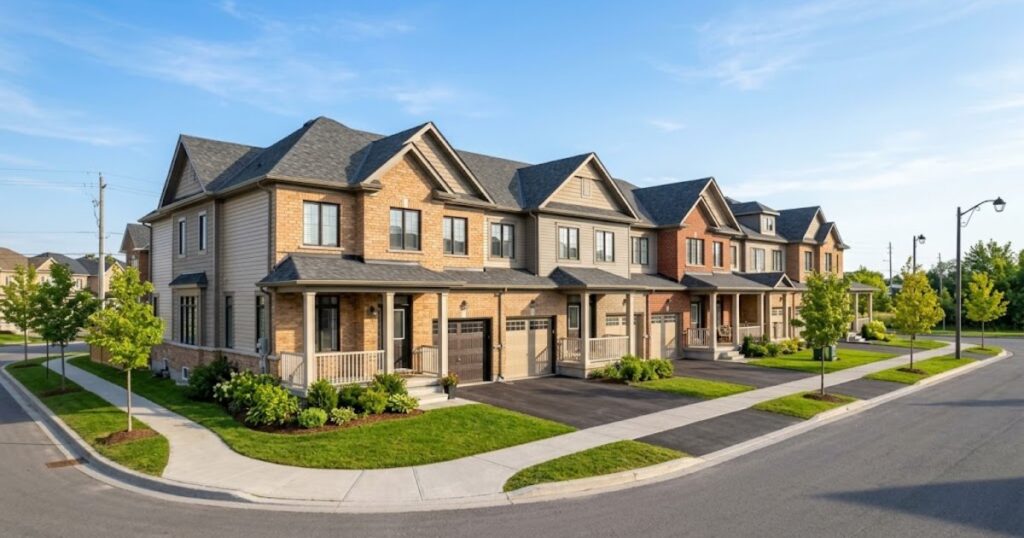
Why Selling a Townhouse in Ottawa Is Different Right Now
Townhouses are Ottawa’s main entry point into ground-level ownership, which makes them popular with first-time buyers, young families, downsizers and investors. That broad appeal is an advantage, but in the current market three factors make townhouse sales more competitive than detached sales.
More supply
Ottawa’s suburbs have added a large number of townhouses over the past two decades, and many owners who bought them are now moving up. That creates a steady flow of resale listings, often in the same communities and floor plans. In late September 2026, there were 396 active Kanata listings in the MLS® feed on this site, and 185 of them, about 47%, were townhouses. The guide to selling your home in Kanata breaks that supply down further.
New-build competition
Builders in Kanata, Stittsville, Barrhaven and Riverside South are still selling new townhomes, sometimes with incentives. First-time buyers compare a resale townhouse with a new one that has a warranty and builder upgrades. Your townhouse needs a clear reason to win that comparison, usually location, a finished basement, a mature lot or a lower total cost.
Price-sensitive buyers
Townhouse buyers are often stretching to qualify. Their budgets are set by the mortgage stress test and their down payment, and many are using savings plans such as the First Home Savings Account. A price that is even slightly too high pushes a townhouse out of their search range entirely, which is why pricing precision matters more here than for most detached homes.
Pricing a Townhouse Against the Real Competition
The biggest pricing mistake townhouse sellers make is anchoring on what a neighbour got last spring. In a market where the benchmark is below last year, those sales are history. What matters is what a buyer can buy instead, this weekend.
Start with your exact model
Townhouses are easier to compare than most homes because many are built to the same plans. Look at recent sales of your model and similar ones in your community within the last 60 to 90 days, then adjust for the differences buyers pay for:
- End unit or interior unit. End units usually have more windows, a side yard and less shared wall.
- Finished basement. Often the single biggest value difference between otherwise identical units.
- What the unit backs onto. Green space or a ravine usually beats another row of homes or a busy road.
- Garage and parking. An attached garage and a driveway that fits two cars matter to Ottawa buyers.
- Updates. Kitchen, bathrooms, flooring and the age of the furnace, air conditioning and roof.
Then look at what is for sale
Next, look at the active and recently expired listings a buyer will see alongside yours. If three similar townhouses are listed nearby, your price and presentation decide whether yours is the one that gets the offer. The guide to why overpricing your home costs you explains how a stale listing ends up selling for less.
Mind the search brackets
Buyers search in price bands. A townhouse listed just above a common threshold, such as a round number, may miss the buyers whose search stops below it. A detailed home value assessment should consider where your price lands in those searches, not just the comparable sales.
Sell Your Ottawa Home for Just 1% Listing Commission
Why pay 2.5% listing commission to sell your home when you don't have to? Jason Polonski lists Ottawa homes for a simple 1% listing commission. Full MLS® and REALTOR.ca exposure, professional photography, powerful online marketing, expert pricing, and a skilled negotiator fighting for every dollar of your sale price. Top-tier service — you just keep thousands more when your home sells. Smart sellers are already making the switch. Your home deserves the best, and your wallet deserves a break.
Preparing a Townhouse to Stand Out
When buyers can tour three versions of the same floor plan in an afternoon, condition and presentation decide which one feels like the best value. Preparation is where a townhouse seller has the most control.
Fix what makes buyers compare unfavourably
- Fresh, neutral paint throughout, especially in the main living area and primary bedroom.
- Clean, repaired flooring, or new flooring where carpet is worn.
- Updated lighting in the kitchen, entry and dining area.
- Serviced mechanicals, with receipts for the furnace and air conditioner.
- A clean, bright basement, even if it is unfinished.
Make the space feel larger
Townhouses are narrower than detached homes, so clutter shows quickly. Remove extra furniture, clear counters and closets, and arrange the main floor so buyers can walk through it easily. The guide to how to stage your home covers the steps in order.
Do not overlook the outside
Front entrances in a row of townhouses are close together, so a clean door, fresh mulch and a tidy walkway make a difference in photos and at the curb. In winter, keep the driveway and steps clear for every showing.
Consider a pre-listing inspection
For an older townhouse, a pre-listing home inspection identifies issues before a buyer’s inspector does. Common items include roof age, attic ventilation, fire separation between units and the condition of shared or adjoining elements. Fixing small items in advance makes your townhouse the easy choice.
Newer townhouses and warranties
If your townhouse is less than seven years old, some of the builder’s statutory warranty coverage may transfer to the next owner. Tarion explains what coverage applies and for how long. Mentioning remaining warranty coverage can help when competing with new builds.
Get Cash Back When You Buy a Home in Ottawa
Can you get cash back when buying a home in Ottawa? Yes. Jason Polonski, a Chairman's Club REALTOR® serving Ottawa and Kanata, shares part of his commission with buyers — up to $3,000 cash back at closing.* You still get full-service, award-winning representation: expert pricing, sharp negotiation, and hands-on guidance from first showing to keys in hand. No cut corners and no rebate-only shortcuts — just real money back in your pocket when you buy your Ottawa or Kanata home.
Freehold, Condo and Stacked Townhouses: What Changes
Not all townhouses are sold the same way. The type of ownership affects what documents buyers need, what conditions they include and how you price.
Freehold townhouses
In a freehold townhouse, you own the house and the land it sits on, with no condominium fees. Sales work much like a detached home. Some freehold townhouses are part of a common elements condominium for shared roads or amenities, which carries a monthly fee and its own documents, so confirm which applies to yours. The guide to townhouse vs detached homes in Ottawa explains the ownership differences buyers weigh.
Condominium townhouses
In a condo townhouse, you own your unit and share ownership of common elements such as roofs, exteriors, roads and landscaping, depending on the corporation’s declaration. Buyers will ask for a status certificate, which summarizes the corporation’s finances, reserve fund and any known issues. Ontario’s Condominium Act sets out what a status certificate must contain, and the Condominium Authority of Ontario provides plain-language information for owners. Order the certificate early so buyers are not left waiting. The guide to status certificates in Ontario explains what buyers look for.
Condo fees and special assessments
Condo fees are part of a buyer’s monthly cost and affect how much they can borrow. A special assessment or an upcoming major project, such as roof replacement, will be in the status certificate and should be addressed in your pricing rather than discovered in the condition period.
Stacked townhouses
Stacked townhouses are almost always condominium units and attract a slightly different buyer, often a first-time buyer or an investor comparing them with apartments. The guide to stacked townhouses explains the format, and the guide to selling a condo in Ottawa covers the condo-specific selling steps.
Freehold vs condo vs stacked townhouses
| Freehold | Condo townhouse | Stacked townhouse | |
|---|---|---|---|
| You own | House and land | Unit plus share of common elements | Unit plus share of common elements |
| Monthly fee | None (unless common elements condo) | Yes | Yes |
| Key document for buyers | Survey, permits | Status certificate | Status certificate |
| Typical buyer | Families, move-up buyers | First-time buyers, downsizers | First-time buyers, investors |
Marketing a Townhouse to the Right Buyers
Every townhouse has a likely buyer. Marketing works best when it speaks to that person directly.
First-time buyers
First-time buyers want move-in condition, a manageable monthly cost and confidence that they are not overpaying. Lead with updates, mechanical receipts, low utility costs and proximity to transit and schools. The CMHC and the federal First Home Savings Account have made many first-time buyers well informed, so a clear, honest listing earns trust.
Downsizers
Downsizers often prefer townhouses with a main-floor primary bedroom, a garage and low exterior maintenance. If your townhouse has a bungalow-style layout or a condo corporation that handles snow and lawn, make that obvious in the photos and description.
Investors
Investors look at rent potential and carrying costs. A finished basement with a separate entrance, a location near transit or a major employer, and a reasonable condo fee all matter to them.
Presentation that travels online
Most buyers decide whether to visit based on photos and virtual tours on REALTOR.ca, the national MLS® platform run by CREA. Professional photography, a floor plan and a virtual tour help your townhouse stand apart from listings that look alike online. The guide to marketing your home in Ottawa explains the full plan.
Timing
Spring usually brings the most buyers, but also the most competing townhouse listings. Fall and winter bring fewer buyers and fewer competitors. With current inventory levels, the best timing is usually when your home is ready and priced right, rather than a particular month.
Selling a Townhouse to Move Up to a Detached Home
Many Ottawa townhouse sellers are also buyers: they are moving up to a detached home with more space. That creates an opportunity and a risk.
The opportunity
Detached prices have held up better than townhouse prices this year, according to OREB’s figures, but buyers of detached homes also have more choice than they did a year ago. That can give a move-up buyer room to negotiate on the purchase while selling into a market that rewards well-priced townhouses.
The risk
The risk is timing: buying before selling and carrying two homes, or selling before buying and having nowhere to go. The guides to moving up in Ottawa and selling and buying at the same time explain bridge financing, conditional offers and closing coordination.
Offers conditional on the sale of the buyer’s home
As a townhouse seller, you may also receive offers from buyers who need to sell their own condo first. Those can work with an escape clause that lets you keep marketing the home, but understand the terms before accepting. Ontario’s real estate regulator, RECO, has guidance for sellers on understanding offers and agreements.
Keep more of your equity
In a move-up, every dollar saved on the sale goes toward the next down payment. Commission is the largest cost of selling and the most negotiable. Jason Polonski’s 1% Listing Commission is designed for exactly this situation: full marketing and negotiation, with more of your equity carried into the next home. The net proceeds calculator shows what you would keep.


Posted on Google 

Jennifer Clark
11 days ago
 Trustindex verifies that the original source of the review is Google.
His availability to communicate was incredible which is so important when selling a house. Great at everything else too.
Posted on Google

Aarushi Govil
22 days ago
Trustindex verifies that the original source of the review is Google. Working with Jason has been an absolute privilege from start to finish. Finding the right realtor can be daunting, but Jason exceeded every expectation. He is remarkably knowledgeable and was extremely punctual and responsive to every question or request we had, no matter the time or the day. What stood out most was his complete sincerity and zero-pressure approach. When we walked through houses, he was transparent, pointing out both the pros and potential red flags instead of trying to make a quick sale. His honest feedback gave us complete confidence in our decision. If you want a dedicated, honest, and highly skilled agent in your corner, look no further than Jason!
Posted on Google

Joe Ireland
36 days ago
Trustindex verifies that the original source of the review is Google. Jason helped me buy my first home.
He was extremely responsive and available from our very first call, and assisted with booking multiple viewings across Ottawa.
He was punctual to every viewing and honest with his feedback with the homes we saw, and when it came time to go from viewing to buying, he had an impressive array of contacts from brokers to inspectors to lawyers, all with excellent reviews and who were great to work with in their own right.
As a first-time home buyer, his responsiveness and patience with many questions were extremely reassuring and really streamlined the process, and I signed an offer on my home within just 2 weeks of meeting him.
I would strongly recommend Jason to anyone buying a home in Ottawa, especially to those who are strangers to the process like I was.
Thank you again, Jason!
Posted on Google

Marina
66 days ago
Trustindex verifies that the original source of the review is Google. We had a wonderful experience working with our realtor - Jason Polonski. He is a professional, knowledgeable, responsive, and truly attentive to our needs. Jason guided us through every step of the process, answered all of our questions. My family are very grateful for his work and would absolutely recommend him to anyone looking for a reliable and trustworthy realtor in Ottawa and around !
Posted on Google

Vatrul “Vatrul”
70 days ago
Trustindex verifies that the original source of the review is Google. First time home seller. Every process of the journey was explained and laid out perfectly.. Very highly recommended.. thank you Jason..
Posted on Google

Olga V.
71 days ago
Trustindex verifies that the original source of the review is Google. Jason is very knowledgeable realtor in Kanata. He’s been always good beyond to help his clients. We had a place experience buying a house in Kanata. I highly recommend him.
Posted on Google

Yuri Tsouker
78 days ago
Trustindex verifies that the original source of the review is Google. Working with Jason on the sale of my property was genuinely one of the smoothest professional experiences I've had. He was responsive at every step, patient with every question (and I had many), and he clearly knew the local market inside and out.
My sale wasn't a simple one — there was a tenant, a rental water heater, a plumber to coordinate, and plenty of complications that made this a genuinely difficult case. Jason handled all of it with calm, practical advice and always got back to me quickly, often with a solution before I even finished asking about the problem.
What stood out most was his honesty. He didn't push, he didn't overpromise, and every recommendation he made turned out to be exactly right. I felt like I had a professional in my corner from day one.
If you're looking for a realtor who is knowledgeable, responsive, and genuinely trustworthy, I can't recommend Jason highly enough. Thank you, Jason — much appreciated!
Posted on Google

Denis Pepin
102 days ago
Trustindex verifies that the original source of the review is Google. Outstanding Experience with Jason Polonski!
Last May, my wife and I sold our home in Stittsville with Jason Polonski, and we couldn't be happier with our decision. Jason made the entire process remarkably smooth and stress-free.
From day one, Jason stood out for his exceptional communication. He was always prompt and available to answer our queries—often within minutes—no matter the time of day. Whenever we had questions regarding paperwork, listing strategies, or handling property details, he addressed every concern with a truly genuine, human touch.
What impressed us most was how proactive and reassuring he was at every step. When we had to coordinate the buyout of our water heater rental, Jason handled the reimbursement seamlessly, reassuring us with, "We should have a smooth sale now. :)"—and it truly was! Even post-closing, when we needed to arrange delivery for mailbox keys or track down final funds from head office, Jason stayed on top of every detail, putting a rush on things and constantly keeping us updated.
Jason is a dedicated, attentive, and highly professional realtor who genuinely cares about his clients. It has been an absolute pleasure working with him, and we highly recommend Jason Polonski to anyone looking to buy or sell a home in the Ottawa region.
Posted on Google

Tammy Puhakka
111 days ago
Trustindex verifies that the original source of the review is Google. I highly recommend Jason Polonski, a realtor in Kanata, Ottawa. He truly went above and beyond for me. During a long weekend, he called me and, within just two hours, had an offer to purchase prepared and sent so I could secure the home I had found and fallen in love with.
Jason was professional, efficient, knowledgeable, and incredibly pleasant to work with. His rates are very reasonable, and his dedication to his clients is outstanding. If you’re looking for fast, reliable, and friendly service, I would absolutely recommend contacting him.❤️
Posted on Google

Joe Melindy
116 days ago
Trustindex verifies that the original source of the review is Google. Everything went smoothly. Jason is very good at what he does. Would highly recommend. Thanks Jason 😊
Selling Your Ottawa Townhouse With Jason Polonski
Jason Polonski is a full-time REALTOR® with Right at Home Realty who has worked in Ottawa real estate for more than 15 years, helping hundreds of buyers and sellers across Kanata, Stittsville, Barrhaven, Riverside South and the rest of the city, including many townhouse owners moving up to their first detached home. He prices townhouses against the listings buyers are actually touring, and works as a move coordinator so the sale and the next purchase line up. Before real estate, he worked in the construction and electrical trades and holds a technical diploma in construction electricity, which helps him identify the condition items that separate one townhouse from the identical unit next door. He also earned a Bachelor of Commerce from Concordia University with a double major in Marketing and Finance, which shapes how he positions a listing for the buyers most likely to pay for it. Call or text Jason at (613) 601-9333, or read his Google reviews.
Browsing the market as a buyer instead? See current townhouses for sale in Ottawa.
Selling a Townhouse in Ottawa (FAQs)
It can be, with the right pricing. OREB’s October 2026 report showed the townhouse benchmark price at $539,800, down 4.3% year over year, with 3.6 months of inventory, so buyers have choice. Townhouses priced against current competition and well presented still sell.
Compare recent sales of the same or similar models in your community from the last 60 to 90 days, adjust for end unit, finished basement, backing, parking and updates, then check the active listings buyers will see alongside yours.
Buyers of condominium townhouses will almost always ask for one. It summarizes the corporation’s finances, reserve fund and known issues. Ordering it early keeps the buyer’s condition period short.
Fresh neutral paint, clean flooring, updated lighting and serviced mechanicals usually give the best return. A finished basement adds significant value, but finishing one just to sell is rarely worth the cost and time.
Usually. End units tend to have more natural light, a side yard and less shared wall, and buyers often pay more for them than for an identical interior unit.
It depends on your finances and the market. Selling first removes the risk of carrying two homes, while buying first secures the next home. Bridge financing and conditional offers can help you line up both.
Buyers compare resale townhouses with new ones that come with warranties and builder upgrades. Highlighting location, a mature lot, a finished basement, lower closing costs or remaining warranty coverage helps your townhouse compete.
