Ottawa Home Buyers
Buying a Home As-Is in Ottawa
By Jason Polonski, REALTOR® with Right at Home Realty · 15+ years in Ottawa real estate · Updated October 2026 · Client reviews
Before you act: This guide is general information, not legal advice. Have a real estate lawyer review any agreement before you sign it or waive a condition. Buyer and seller rights in Ontario are overseen by the Real Estate Council of Ontario (RECO).
Buying a home as-is means the seller offers it in its current condition and will not make repairs or provide warranties about its state. It does not, however, prevent the buyer from arranging their own inspection, and in Ontario a seller still cannot conceal a known, dangerous hidden defect. This guide is written for buyers; if you are the owner, see how to sell a home as-is in Ottawa.
An as-is purchase can be a genuine opportunity, often at a lower price and with less competition, but it shifts the responsibility for condition onto the buyer. That makes due diligence more important, not less.
Jason Polonski is a full-time Ottawa and Kanata REALTOR® with Right at Home Realty whose trades background is especially valuable on as-is purchases. Buyers can reach him by phone at (613) 601-9333 or by email at polonskiottawa@gmail.com.
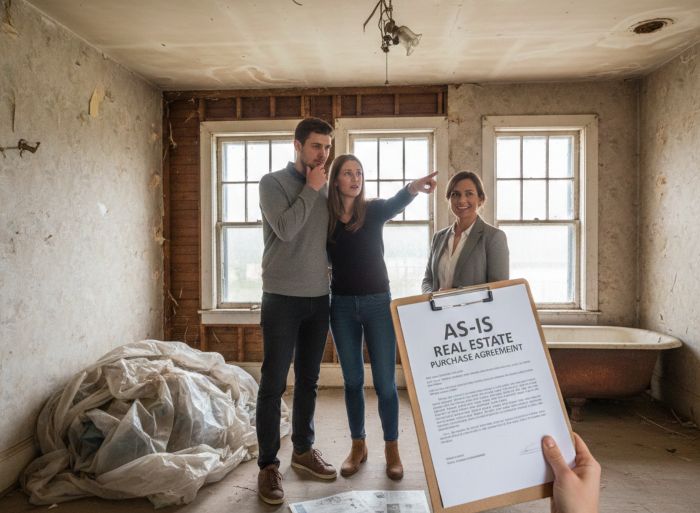
What “As-Is” Means in Ontario Real Estate
An as-is, where-is clause tells the buyer that the seller makes no representations or warranties about the property’s condition and will not repair anything before closing. The buyer accepts the home in its present state.
Sellers use the clause to limit their liability and to avoid negotiating repairs. It is common where the seller does not know the home well, such as an estate or a lender selling through power of sale.
The clause changes what the seller promises, but it does not remove the buyer’s ability to investigate before committing. Understanding that distinction is the key to buying as-is safely.
Why Homes Are Sold As-Is
Several situations lead to an as-is sale. Estate sales are common, since the sellers are often settling an estate and did not live in the home, and power-of-sale properties are typically sold as-is because the lender does not know the home’s history.
Relocations, tenanted properties and homes with deferred maintenance also appear as-is when a seller prefers certainty over repairs. Jason’s guide to finding a bargain-priced home explains how these situations can offer value.
In each case, the reason for the as-is clause shapes the risk, which is why understanding the seller’s situation matters.
What As-Is Does Not Mean
As-is is widely misunderstood, and clearing up the misconceptions protects buyers. It does not mean the buyer must skip an inspection, and it does not give a seller a licence to hide serious problems.
Ontario follows the principle of buyer beware for patent defects, the visible issues a buyer could find on a reasonable inspection. However, a seller cannot fraudulently conceal a known latent defect, a hidden problem that makes the home dangerous or unfit to live in. The non-profit resource Steps to Justice explains these principles, and a real estate lawyer should always be involved.
In short, as-is limits the seller’s promises but does not eliminate the buyer’s rights, so due diligence remains essential.
Sell Your Ottawa Home for Just 1% Listing Commission
Why pay 2.5% listing commission to sell your home when you don't have to? Jason Polonski lists Ottawa homes for a 1% listing commission, charged on the final sale price; the buyer-side commission is separate. Full MLS® and REALTOR.ca exposure, professional photography, powerful online marketing, expert pricing, and a skilled negotiator fighting for every dollar of your sale price. Top-tier service — you just keep thousands more when your home sells. Smart sellers are already making the switch. Your home deserves the best, and your wallet deserves a break.
Pros and Cons of Buying As-Is
An as-is purchase carries clear advantages and real risks. The table below weighs them.
| Advantages | Risks |
|---|---|
| Often a lower purchase price | Full responsibility for repairs |
| Less competition from other buyers | Potential for costly hidden issues |
| Opportunity in estate and power-of-sale homes | Financing can be harder |
| Room to add value through renovation | No recourse for known patent defects |
For the right buyer, the trade-off is worthwhile. For an unprepared buyer stretching their budget, the risks can outweigh the discount.
Get Cash Back When You Buy a Home in Ottawa
Can you get cash back when buying a home in Ottawa? Yes. Jason Polonski, a Chairman's Club REALTOR® serving Ottawa and Kanata, shares part of his commission with buyers — up to $3,000 cash back at closing on qualifying purchases (conditions apply). You still get full-service, award-winning representation: expert pricing, sharp negotiation, and hands-on guidance from first showing to keys in hand. No cut corners and no rebate-only shortcuts — just real money back in your pocket when you buy your Ottawa or Kanata home.
Home Inspections on As-Is Properties
An inspection is more important on an as-is home, not less. Even though the seller will not make repairs, the buyer needs to know exactly what they are taking on before committing.
The key is to keep the inspection as a condition for information, so the buyer can walk away if it reveals something unacceptable, even though they cannot demand repairs. Jason’s guides to home inspections in Ottawa and what to look for in a home inspection explain what to check and how to read the findings.
Older as-is homes may warrant extra testing for asbestos or radon, or an assessment of an oil tank, and choosing an inspector accredited by the Ontario Association of Home Inspectors adds confidence. Jason’s trades background helps buyers interpret it all.

Legal Risks and Due Diligence
An as-is purchase raises the stakes on legal due diligence. A real estate lawyer, who can be found through the Law Society of Ontario, should review the agreement, complete a title search, and arrange title insurance, which protects against title defects and fraud, as the Financial Services Regulatory Authority of Ontario explains.
For a condo sold as-is, the status certificate is essential, since it reveals the corporation’s finances and any special assessments. Consumer protections and agent conduct in Ontario are overseen by the Real Estate Council of Ontario, and the Government of Ontario publishes guidance on the buying process.
Skipping this due diligence on an as-is home is where buyers get caught, so it is never the place to cut corners.
Financing an As-Is Home
Financing can be the biggest hurdle. Lenders assess a property’s condition, and a home with major deficiencies may not qualify for a standard or insured mortgage until issues are addressed.
Buyers have options. A renovation mortgage can finance the purchase and the repairs together, and some buyers use cash or home equity for homes that will not qualify conventionally. The Canada Mortgage and Housing Corporation and the Financial Consumer Agency of Canada offer guidance on these paths.
Confirming financing for a specific as-is property before making a firm offer prevents a failed closing.
Negotiating an As-Is Purchase
Negotiating as-is is different, since the seller will not make repairs. The strategy is to use the inspection findings to justify a lower price rather than to request work.
A well-supported offer based on the real cost of repairs is both fair and persuasive, especially with a motivated seller. Jason’s guide to negotiating a better deal explains how to turn condition into leverage.
The goal is a price that reflects the work the home actually needs, so the discount is real rather than illusory.
Who Should Consider Buying As-Is?
An as-is home suits buyers who are prepared for the responsibility. Investors, handy buyers and those willing to renovate can find real value where others see only risk.
Buyers who want to add value through renovation should read Jason’s guide to buying a home that needs work, and those drawn to character homes will find his guide to buying an older home in Ottawa useful. Investors can explore real estate investing in Ottawa.
For a buyer wanting a move-in-ready home with full peace of mind, an as-is purchase is usually not the right fit.


Posted on Google 

Jennifer Clark
10 days ago
 Trustindex verifies that the original source of the review is Google.
His availability to communicate was incredible which is so important when selling a house. Great at everything else too.
Posted on Google

Aarushi Govil
21 days ago
Trustindex verifies that the original source of the review is Google. Working with Jason has been an absolute privilege from start to finish. Finding the right realtor can be daunting, but Jason exceeded every expectation. He is remarkably knowledgeable and was extremely punctual and responsive to every question or request we had, no matter the time or the day. What stood out most was his complete sincerity and zero-pressure approach. When we walked through houses, he was transparent, pointing out both the pros and potential red flags instead of trying to make a quick sale. His honest feedback gave us complete confidence in our decision. If you want a dedicated, honest, and highly skilled agent in your corner, look no further than Jason!
Posted on Google

Joe Ireland
35 days ago
Trustindex verifies that the original source of the review is Google. Jason helped me buy my first home.
He was extremely responsive and available from our very first call, and assisted with booking multiple viewings across Ottawa.
He was punctual to every viewing and honest with his feedback with the homes we saw, and when it came time to go from viewing to buying, he had an impressive array of contacts from brokers to inspectors to lawyers, all with excellent reviews and who were great to work with in their own right.
As a first-time home buyer, his responsiveness and patience with many questions were extremely reassuring and really streamlined the process, and I signed an offer on my home within just 2 weeks of meeting him.
I would strongly recommend Jason to anyone buying a home in Ottawa, especially to those who are strangers to the process like I was.
Thank you again, Jason!
Posted on Google

Marina
65 days ago
Trustindex verifies that the original source of the review is Google. We had a wonderful experience working with our realtor - Jason Polonski. He is a professional, knowledgeable, responsive, and truly attentive to our needs. Jason guided us through every step of the process, answered all of our questions. My family are very grateful for his work and would absolutely recommend him to anyone looking for a reliable and trustworthy realtor in Ottawa and around !
Posted on Google

Vatrul “Vatrul”
69 days ago
Trustindex verifies that the original source of the review is Google. First time home seller. Every process of the journey was explained and laid out perfectly.. Very highly recommended.. thank you Jason..
Posted on Google

Olga V.
70 days ago
Trustindex verifies that the original source of the review is Google. Jason is very knowledgeable realtor in Kanata. He’s been always good beyond to help his clients. We had a place experience buying a house in Kanata. I highly recommend him.
Posted on Google

Yuri Tsouker
77 days ago
Trustindex verifies that the original source of the review is Google. Working with Jason on the sale of my property was genuinely one of the smoothest professional experiences I've had. He was responsive at every step, patient with every question (and I had many), and he clearly knew the local market inside and out.
My sale wasn't a simple one — there was a tenant, a rental water heater, a plumber to coordinate, and plenty of complications that made this a genuinely difficult case. Jason handled all of it with calm, practical advice and always got back to me quickly, often with a solution before I even finished asking about the problem.
What stood out most was his honesty. He didn't push, he didn't overpromise, and every recommendation he made turned out to be exactly right. I felt like I had a professional in my corner from day one.
If you're looking for a realtor who is knowledgeable, responsive, and genuinely trustworthy, I can't recommend Jason highly enough. Thank you, Jason — much appreciated!
Posted on Google

Denis Pepin
101 days ago
Trustindex verifies that the original source of the review is Google. Outstanding Experience with Jason Polonski!
Last May, my wife and I sold our home in Stittsville with Jason Polonski, and we couldn't be happier with our decision. Jason made the entire process remarkably smooth and stress-free.
From day one, Jason stood out for his exceptional communication. He was always prompt and available to answer our queries—often within minutes—no matter the time of day. Whenever we had questions regarding paperwork, listing strategies, or handling property details, he addressed every concern with a truly genuine, human touch.
What impressed us most was how proactive and reassuring he was at every step. When we had to coordinate the buyout of our water heater rental, Jason handled the reimbursement seamlessly, reassuring us with, "We should have a smooth sale now. :)"—and it truly was! Even post-closing, when we needed to arrange delivery for mailbox keys or track down final funds from head office, Jason stayed on top of every detail, putting a rush on things and constantly keeping us updated.
Jason is a dedicated, attentive, and highly professional realtor who genuinely cares about his clients. It has been an absolute pleasure working with him, and we highly recommend Jason Polonski to anyone looking to buy or sell a home in the Ottawa region.
Posted on Google

Tammy Puhakka
110 days ago
Trustindex verifies that the original source of the review is Google. I highly recommend Jason Polonski, a realtor in Kanata, Ottawa. He truly went above and beyond for me. During a long weekend, he called me and, within just two hours, had an offer to purchase prepared and sent so I could secure the home I had found and fallen in love with.
Jason was professional, efficient, knowledgeable, and incredibly pleasant to work with. His rates are very reasonable, and his dedication to his clients is outstanding. If you’re looking for fast, reliable, and friendly service, I would absolutely recommend contacting him.❤️
Posted on Google

Joe Melindy
115 days ago
Trustindex verifies that the original source of the review is Google. Everything went smoothly. Jason is very good at what he does. Would highly recommend. Thanks Jason 😊
How Jason Polonski Helps Buyers of As-Is Homes
An as-is purchase rewards an honest read of condition, which is exactly where Jason excels. His hands-on background in construction and the electrical trades helps buyers understand the true cost of a home’s issues before they commit.
That expertise, paired with a Bachelor of Commerce in Marketing and Finance, means buyers get both a clear picture of condition and a disciplined view of the numbers. Hundreds of buyers and sellers across Ottawa have trusted him with their purchases.
He has been recognized as Best in Ottawa Top REALTOR® for 2026, seven years running, along with Top Choice REALTOR® honours for Kanata and Stittsville. More is on the About Jason Polonski page, and current reviews are on his Google Business Profile.
Ready to Explore an As-Is Purchase in Ottawa?
An as-is home can be a smart buy with the right preparation and an agent who reads condition accurately. Jason Polonski helps buyers weigh the risk and the opportunity honestly.
A short, no-obligation conversation about goals, budget and timeline is the best place to begin. Buyers can reach Jason directly by phone at (613) 601-9333 or by email at polonskiottawa@gmail.com, or return to the full buying a house in Ottawa guide for more.
Buying a Home As-Is in Ottawa (FAQs)
It means the seller offers the home in its current condition and will not make repairs or provide warranties about its state. The buyer accepts responsibility for the property’s condition, though they can still arrange an inspection before committing.
Yes. An as-is clause does not prevent an inspection, and it is more important than usual. Keeping the inspection as a condition lets the buyer walk away if it reveals an unacceptable problem, even though they cannot demand repairs.
No. Ontario follows buyer beware for visible, patent defects, but a seller cannot fraudulently conceal a known latent defect that makes the home dangerous or unfit to live in. A lawyer should always be involved in an as-is purchase.
Common reasons include estate sales, power-of-sale properties, relocations and homes with deferred maintenance. In many of these cases, the seller does not know the home well or prefers certainty over negotiating repairs.
Sometimes, a home with major deficiencies may not qualify for a standard or insured mortgage. Renovation mortgages, cash or home equity are alternatives, and financing should be confirmed for the specific property before making a firm offer.
Buyers reach out by phone at (613) 601-9333 or email at polonskiottawa@gmail.com. Jason begins with a no-obligation conversation about goals, budget and timeline before the search begins.
