OTTAWA HOME BUYERS
What Is a Stacked Townhouse? Pros, Cons and What Ottawa Buyers Should Know
By Jason Polonski, REALTOR® with Right at Home Realty · 15+ years in Ottawa real estate · Updated October 2026 · Client reviews
Last updated: October 2026
A stacked townhouse is a townhouse-style building where one home sits on top of another, so the building contains units stacked vertically as well as side by side, and every unit has its own exterior entrance. In Ottawa, stacked townhouses are almost always sold as condominiums: you own your unit outright, share ownership of the building and grounds with your neighbours, and pay a monthly condo fee.
They’re common in Ottawa’s newer suburbs, and they often appeal to first-time buyers, downsizers and investors because they cost less than a traditional townhouse and come without the elevators and amenities of a high-rise. This guide explains how they work, how they compare with other home types, the real pros and cons, and what to check before you buy. For the broader decision, start with our guide to buying a house in Ottawa.

How a Stacked Townhouse Works
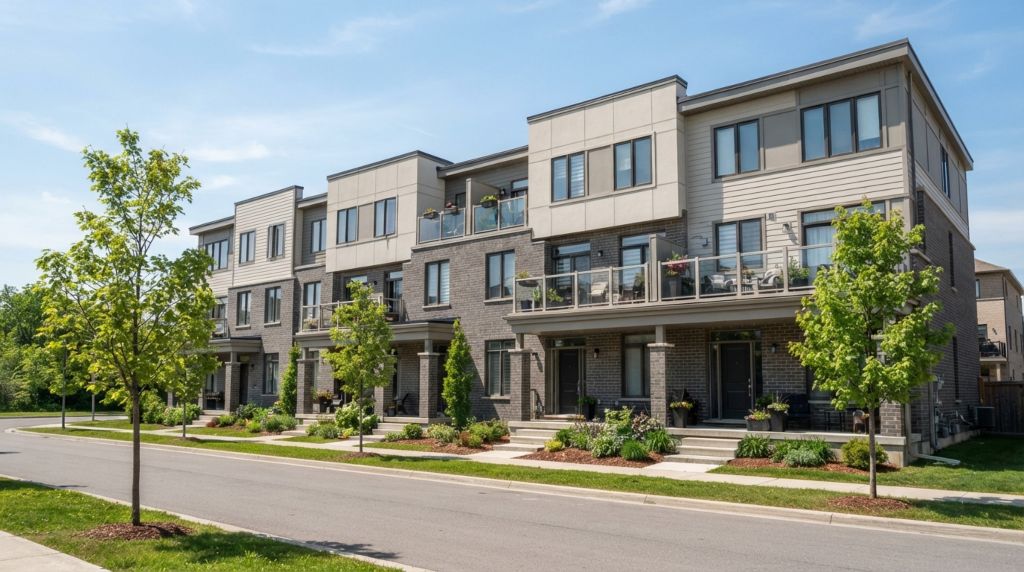
Picture a row of townhouses, then split each one horizontally into two homes. The lower unit typically occupies the ground floor and often a partly below-grade level. The upper unit usually starts one storey up, reached by an exterior staircase, and spreads over two floors, sometimes with a rooftop terrace or a balcony.
Common layouts
- Lower units: one or two levels, often with bedrooms on a lower level that’s partly below ground, plus a small patio or terrace at grade.
- Upper units: two levels above the lower unit, usually with more natural light and a balcony or rooftop terrace, but more stairs.
- Back-to-back stacked towns: units share a rear wall as well as side walls, so most homes have windows on only one side.
Ownership and fees
Because units sit on top of one another, you can’t own the land under your home individually. Instead, the building is registered as a condominium under Ontario’s Condominium Act, 1998. You own your unit and share the common elements, such as the roof, exterior walls, foundations, walkways and landscaping, with the other owners. The condominium corporation maintains those areas, funded by monthly fees and a reserve fund for major repairs.
Where you’ll find them in Ottawa
Stacked towns are a staple of newer suburban communities such as Barrhaven, Riverside South, Findlay Creek, Orléans and Kanata, and they’re increasingly used on infill sites near transit. Builders like them because they fit more homes on the same land, which is why they’re usually priced below row townhouses in the same area.
Stacked Townhouse vs Townhouse vs Condo Apartment
The easiest way to understand a stacked townhouse is to compare it with the two homes it sits between.
| Feature | Stacked townhouse | Row (freehold) townhouse | Condo apartment |
|---|---|---|---|
| Ownership | Condominium unit | Usually freehold; sometimes a common-elements condo with a small fee | Condominium unit |
| Monthly condo fee | Yes, usually moderate | None, or small for a common-elements condo | Yes, usually highest |
| Front door | Private, at the exterior | Private, at the exterior | Shared lobby and hallway |
| Neighbours | Beside, above or below | Beside only | Beside, above and below |
| Elevator | No | No | Usually |
| Outdoor space | Patio, balcony or rooftop terrace | Private backyard | Balcony |
| Garage | Rare; usually one surface spot | Usually a single garage | Underground parking |
| Exterior maintenance | Condo corporation | Owner | Condo corporation |
For more on these trade-offs, see condo vs freehold in Ottawa and our townhouse vs detached home comparison.
Sell Your Ottawa Home for Just 1% Listing Commission
Why pay 2.5% listing commission to sell your home when you don't have to? Jason Polonski lists Ottawa homes for a simple 1% listing commission. Full MLS® and REALTOR.ca exposure, professional photography, powerful online marketing, expert pricing, and a skilled negotiator fighting for every dollar of your sale price. Top-tier service — you just keep thousands more when your home sells. Smart sellers are already making the switch. Your home deserves the best, and your wallet deserves a break.
The Pros of Buying a Stacked Townhouse
A lower purchase price
Stacked towns are usually one of the most affordable ways to get a townhouse-style home with a private entrance in Ottawa’s suburbs. That lower entry price can mean a smaller down payment and a smaller mortgage.
Lower condo fees than most apartments
Without elevators, corridors, concierge services, pools or underground garages to maintain, stacked town fees are usually lower than in a high-rise condo of a similar size. The fee still covers real costs, such as roof replacement, snow removal and landscaping, which is why the reserve fund matters.
A private front door
Many buyers simply don’t want to share a lobby or wait for an elevator. A stacked town gives you a house-like arrival, direct access to your parking spot and an easier move-in day.
Less maintenance
The condo corporation looks after the roof, siding, windows (depending on the declaration), landscaping and snow. For busy professionals, frequent travellers and downsizers, that’s a major advantage over a freehold townhouse.
Newer construction
Many of Ottawa’s stacked towns are relatively new, so they generally have modern layouts, efficient mechanical systems and current building code standards for fire separation and sound transmission between units.
Get Cash Back When You Buy a Home in Ottawa
Can you get cash back when buying a home in Ottawa? Yes. Jason Polonski, a Chairman's Club REALTOR® serving Ottawa and Kanata, shares part of his commission with buyers — up to $3,000 cash back at closing.* You still get full-service, award-winning representation: expert pricing, sharp negotiation, and hands-on guidance from first showing to keys in hand. No cut corners and no rebate-only shortcuts — just real money back in your pocket when you buy your Ottawa or Kanata home.
The Cons and What to Watch For
Jason Polonski’s construction and electrical trades background shapes this section. These are the issues worth checking before you fall for a stacked town.
Noise from above and below
The Ontario Building Code sets minimum sound-transmission ratings for walls and floors between units, but meeting the minimum isn’t the same as quiet. Airborne sound such as voices is usually well controlled; impact noise such as footsteps on a hard floor above is the most common complaint. If you’re looking at a lower unit, visit in the evening when neighbours are home, and ask whether the corporation’s rules require underlay or area rugs on upper floors.
Stairs, and more stairs
Upper units often involve an exterior staircase plus two or three interior flights. That’s fine at 30 and harder at 75, or with a toddler and groceries. Lower units have fewer stairs but may put bedrooms partly below grade.
Below-grade bedrooms and moisture
Partly below-grade rooms need properly sized egress windows, well-drained window wells and good ventilation. Look for staining, musty smells, efflorescence on the walls and how the heat recovery ventilator or dehumidifier is set up.
Shared roofs and building envelope
If you own the lower unit, a leak from a rooftop terrace or a plumbing failure upstairs can become your problem very quickly. Know what the declaration says about who repairs what, how high the corporation’s insurance deductible is, and when the roof and terrace membranes are due for replacement.
Mechanical systems in tight spaces
Furnaces, water heaters, air conditioners and ventilators are often squeezed into small closets, which makes servicing harder. In Ottawa, water heaters and sometimes furnaces are frequently rented rather than owned, so ask for the rental contracts and monthly costs before you firm up.
Parking and storage
Most stacked towns come with one assigned surface spot and limited storage. If you have two cars, bikes, a kayak or seasonal tires, factor in the space you’ll be giving up.
Resale competition
Because builders keep adding stacked units in growing suburbs, resale owners often compete with new inventory. Condo segments have been the softest part of Ottawa’s market in 2026, with condo apartment inventory at 6.3 months in August according to the Ottawa Real Estate Board. That’s good news if you’re buying, but plan to hold for several years.
What Does a Stacked Townhouse Cost in Ottawa?
Prices vary widely depending on the community, the age of the building, the size of the unit and whether it’s an upper or lower unit. As a general pattern in Ottawa, stacked towns sell for less than freehold row townhouses in the same neighbourhood and can compete with many condo apartments while offering more space and a private entrance. Upper units with terraces often sell for more than lower units in the same building.
Ottawa market statistics don’t track stacked towns as their own category, so board-wide townhouse or apartment averages won’t tell you what a specific unit is worth. The only reliable guide is recent sales of similar units in the same complex or a comparable one nearby. That’s the comparison Jason pulls for every stacked town his clients consider.
Budget for the full monthly cost
Your real monthly cost is the mortgage payment plus condo fees, property taxes, utilities and any equipment rentals. Lenders count condo fees too; most include a portion of the monthly fee when calculating how much you can borrow. Use our Ottawa mortgage calculator as a starting point, and see how much you need for a down payment. The Financial Consumer Agency of Canada explains the minimum down payment rules.
How to Buy a Stacked Townhouse in Ottawa: A Checklist
Review the status certificate
For a resale unit, make your offer conditional on your lawyer reviewing the status certificate. It shows the reserve fund balance, any special assessments, legal actions, insurance coverage and fee increases. The Condominium Authority of Ontario explains what’s in it and the rules for requesting one. Our guide on status certificates in Ontario covers what to look for.
Read the declaration and rules
Check who is responsible for windows, doors, balconies and terraces, plus the rules on pets, rentals, barbecues and renovations. These vary a lot from one corporation to another.
Get a proper inspection
A condo unit still deserves a home inspection: mechanical systems, electrical panel, windows, moisture in lower levels, and the condition of the terrace or balcony you’ll use.
Buying new from a builder
New stacked towns come with Tarion warranty coverage and deposit protection, but Ontario new condos often include an interim occupancy period, when you live in the unit and pay an occupancy fee before the building is registered and you take title. Read the agreement with a lawyer before signing. Our guide to buying a new build home in Ottawa covers the process.
If you’re buying to rent it out
Confirm that the corporation allows rentals and whether short stays are restricted. Ottawa’s short-term rental by-law generally limits short-term rentals in urban areas to the host’s principal residence. For long-term rentals, units first occupied after November 15, 2018 are exempt from Ontario’s annual rent increase guideline.
Who Should Consider a Stacked Townhouse?
- First-time buyers who want a private entrance and more space than an apartment at a lower price than a freehold town. See our Ottawa first-time home buyer guide.
- Downsizers who want low maintenance and can manage stairs, or who choose a lower unit to limit them.
- Investors looking for a newer, lower-maintenance rental in a suburb with steady tenant demand.
They’re a weaker fit for families who need a fenced yard, buyers with mobility concerns considering an upper unit, and anyone who needs a garage or lots of storage.


Posted on Google 

Jennifer Clark
10 days ago
 Trustindex verifies that the original source of the review is Google.
His availability to communicate was incredible which is so important when selling a house. Great at everything else too.
Posted on Google

Aarushi Govil
21 days ago
Trustindex verifies that the original source of the review is Google. Working with Jason has been an absolute privilege from start to finish. Finding the right realtor can be daunting, but Jason exceeded every expectation. He is remarkably knowledgeable and was extremely punctual and responsive to every question or request we had, no matter the time or the day. What stood out most was his complete sincerity and zero-pressure approach. When we walked through houses, he was transparent, pointing out both the pros and potential red flags instead of trying to make a quick sale. His honest feedback gave us complete confidence in our decision. If you want a dedicated, honest, and highly skilled agent in your corner, look no further than Jason!
Posted on Google

Joe Ireland
35 days ago
Trustindex verifies that the original source of the review is Google. Jason helped me buy my first home.
He was extremely responsive and available from our very first call, and assisted with booking multiple viewings across Ottawa.
He was punctual to every viewing and honest with his feedback with the homes we saw, and when it came time to go from viewing to buying, he had an impressive array of contacts from brokers to inspectors to lawyers, all with excellent reviews and who were great to work with in their own right.
As a first-time home buyer, his responsiveness and patience with many questions were extremely reassuring and really streamlined the process, and I signed an offer on my home within just 2 weeks of meeting him.
I would strongly recommend Jason to anyone buying a home in Ottawa, especially to those who are strangers to the process like I was.
Thank you again, Jason!
Posted on Google

Marina
65 days ago
Trustindex verifies that the original source of the review is Google. We had a wonderful experience working with our realtor - Jason Polonski. He is a professional, knowledgeable, responsive, and truly attentive to our needs. Jason guided us through every step of the process, answered all of our questions. My family are very grateful for his work and would absolutely recommend him to anyone looking for a reliable and trustworthy realtor in Ottawa and around !
Posted on Google

Vatrul “Vatrul”
69 days ago
Trustindex verifies that the original source of the review is Google. First time home seller. Every process of the journey was explained and laid out perfectly.. Very highly recommended.. thank you Jason..
Posted on Google

Olga V.
70 days ago
Trustindex verifies that the original source of the review is Google. Jason is very knowledgeable realtor in Kanata. He’s been always good beyond to help his clients. We had a place experience buying a house in Kanata. I highly recommend him.
Posted on Google

Yuri Tsouker
77 days ago
Trustindex verifies that the original source of the review is Google. Working with Jason on the sale of my property was genuinely one of the smoothest professional experiences I've had. He was responsive at every step, patient with every question (and I had many), and he clearly knew the local market inside and out.
My sale wasn't a simple one — there was a tenant, a rental water heater, a plumber to coordinate, and plenty of complications that made this a genuinely difficult case. Jason handled all of it with calm, practical advice and always got back to me quickly, often with a solution before I even finished asking about the problem.
What stood out most was his honesty. He didn't push, he didn't overpromise, and every recommendation he made turned out to be exactly right. I felt like I had a professional in my corner from day one.
If you're looking for a realtor who is knowledgeable, responsive, and genuinely trustworthy, I can't recommend Jason highly enough. Thank you, Jason — much appreciated!
Posted on Google

Denis Pepin
101 days ago
Trustindex verifies that the original source of the review is Google. Outstanding Experience with Jason Polonski!
Last May, my wife and I sold our home in Stittsville with Jason Polonski, and we couldn't be happier with our decision. Jason made the entire process remarkably smooth and stress-free.
From day one, Jason stood out for his exceptional communication. He was always prompt and available to answer our queries—often within minutes—no matter the time of day. Whenever we had questions regarding paperwork, listing strategies, or handling property details, he addressed every concern with a truly genuine, human touch.
What impressed us most was how proactive and reassuring he was at every step. When we had to coordinate the buyout of our water heater rental, Jason handled the reimbursement seamlessly, reassuring us with, "We should have a smooth sale now. :)"—and it truly was! Even post-closing, when we needed to arrange delivery for mailbox keys or track down final funds from head office, Jason stayed on top of every detail, putting a rush on things and constantly keeping us updated.
Jason is a dedicated, attentive, and highly professional realtor who genuinely cares about his clients. It has been an absolute pleasure working with him, and we highly recommend Jason Polonski to anyone looking to buy or sell a home in the Ottawa region.
Posted on Google

Tammy Puhakka
110 days ago
Trustindex verifies that the original source of the review is Google. I highly recommend Jason Polonski, a realtor in Kanata, Ottawa. He truly went above and beyond for me. During a long weekend, he called me and, within just two hours, had an offer to purchase prepared and sent so I could secure the home I had found and fallen in love with.
Jason was professional, efficient, knowledgeable, and incredibly pleasant to work with. His rates are very reasonable, and his dedication to his clients is outstanding. If you’re looking for fast, reliable, and friendly service, I would absolutely recommend contacting him.❤️
Posted on Google

Joe Melindy
115 days ago
Trustindex verifies that the original source of the review is Google. Everything went smoothly. Jason is very good at what he does. Would highly recommend. Thanks Jason 😊
Buy the Right Stacked Townhouse With Jason Polonski
Two stacked towns in the same complex can be very different purchases: one has a healthy reserve fund and a quiet neighbour, the other has a looming terrace replacement and a lower bedroom that smells damp. Jason Polonski is a REALTOR® with Right at Home Realty with more than 15 years of experience in Ottawa real estate, and his construction and electrical trades background helps him spot those differences during a showing. He also holds a Bachelor of Commerce from Concordia University with a double major in Marketing and Finance, so he can walk you through the condo fees, reserve fund and resale outlook with the same care.
Eligible buyers can receive up to $3,000 cash back through his cash back program, and owners selling a stacked town can list with a 1% Listing Commission, charged on the final sold price. Learn more about Jason, read his Google reviews, or call (613) 601-9333.
See also: our guide to buying a condo in Ottawa.
Frequently Asked Questions
A stacked townhouse is a townhouse-style building in which one unit sits on top of another, each with its own exterior entrance. In Ontario they’re usually condominiums, so owners pay monthly condo fees.
In Ottawa, almost always. Because units are stacked vertically, they can’t sit on individually owned land, so they’re registered as condominium units with shared common elements.
They can be, especially as newer, low-maintenance rentals. Returns depend on the purchase price, condo fees, rental rules and local competition from new supply, so compare recent sales and rents in the specific complex.
A stacked townhouse places units on top of one another. A back-to-back townhouse shares a rear wall as well as side walls. Some buildings are both, with units stacked vertically and placed back to back.
Footsteps from the unit above are the most common complaint. Building code standards limit sound transmission, but construction quality varies, so visit in the evening and ask about flooring rules.
Yes. Fees cover shared costs such as roofs, exteriors, landscaping, snow removal and the reserve fund. They’re usually lower than in high-rise condos because there are no elevators or amenities to maintain.
