Ottawa Home Sellers
Best Paint Colours to Sell Your Home in Ottawa
By Jason Polonski, REALTOR® with Right at Home Realty · 15+ years in Ottawa real estate · Updated November 2026 · Client reviews
Last updated: November 2026
The best paint colours to sell your home are soft, warm neutrals — warm whites, greiges, gentle greys, and pale earthy tones — because they photograph beautifully, make rooms feel larger and brighter, and let buyers imagine their own furniture and style in the space. Bold, dark, or highly personal colours do the opposite: they narrow appeal, can make rooms feel smaller, and give buyers a reason to mentally deduct for repainting. A fresh, neutral coat is one of the highest-return, lowest-cost updates before selling.
Here’s what to paint, what to avoid, and where a little colour is still welcome.
Paint is one step in a bigger plan. Our guide on how to stage your home covers the rest.
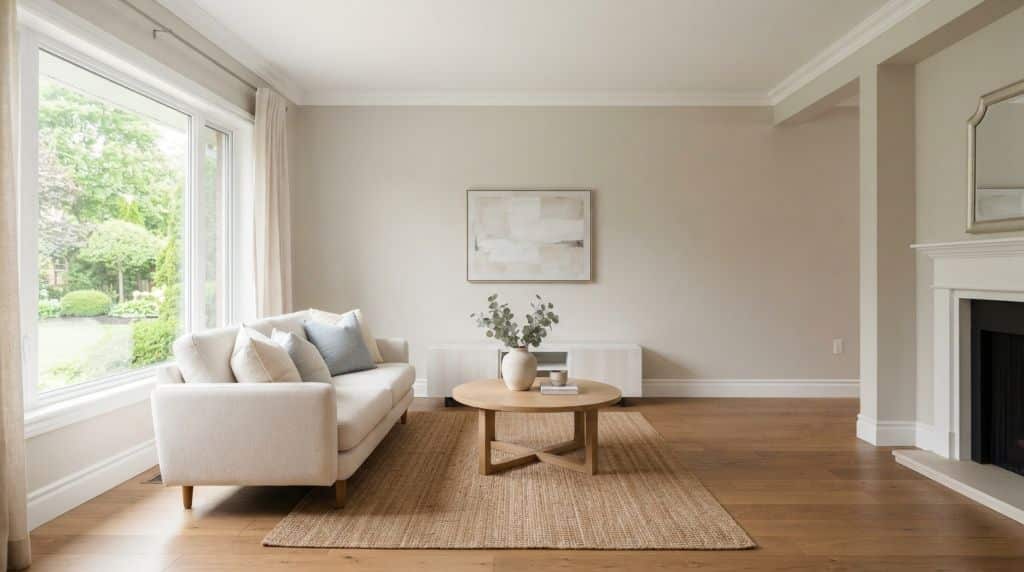
Why neutral colours sell
Neutral doesn’t mean boring — it means broadly appealing. A soft neutral palette does three jobs at once: it reflects light so rooms feel bigger and brighter, it photographs cleanly so your listing images shine, and it acts as a blank canvas so any buyer can picture their own belongings in the home. Buyers form impressions online first, and neutral walls consistently look better in photos on REALTOR.ca than bold or dated colours.
Personal colour choices, by contrast, force buyers to either love your taste or plan to repaint — and “I’d have to repaint” is a small friction that can cost you the emotional yes. That’s why stagers and listing agents lean on neutrals so consistently. It’s worth remembering that you’re not decorating for yourself here — you’re creating the widest possible welcome, and neutral walls are simply the most reliable way to do that.
The best colours by area
Whole-home base: a warm white or soft greige creates flow and lightness throughout, and keeping most of the home in one gentle neutral makes it feel larger and more cohesive.
Living areas: warm whites, greiges, and soft, warm greys feel inviting and let furniture and light do the work.
Kitchens: light, clean neutrals keep kitchens feeling fresh and spacious; very dark or bold kitchen walls tend to date quickly and shrink the room.
Bedrooms: soft, restful neutrals — warm whites, pale greys, gentle taupes — read as calm and universally appealing. For more, see primary bedroom staging tips.
Bathrooms: clean, light neutrals give a spa-like, hygienic impression that buyers respond to.
Front door and exterior accents: here a tasteful pop is welcome — more on that below.
Warm vs cool neutrals, and Ottawa light.
Not all neutrals are equal, and the warm-versus-cool choice matters more than people expect. Cool greys were hugely popular for years but can read cold and even slightly dated now, and in a north-facing or low-light Ottawa room they can feel grey and flat. Warm neutrals — warm whites, greiges, soft taupes — tend to feel more inviting and flatter our light, especially through long, grey Ottawa winters.
The practical tip: test any colour in the actual room, at different times of day, before committing, because the same paint looks different in morning light, evening light, and under your bulbs. What looks like a soft warm beige in the store can go pink or yellow on a wall. Ottawa’s strong seasonal light swings make this test especially worthwhile. Bulbs matter too, since paint looks different under warm and cool LEDs; test under the bulbs you’ll have in during showings, and see Natural Resources Canada’s ENERGY STAR lighting guidance on choosing them.
Sell Your Ottawa Home for Just 1% Listing Commission
Why pay 2.5% listing commission to sell your home when you don't have to? Jason Polonski lists Ottawa homes for a simple 1% listing commission. Full MLS® and REALTOR.ca exposure, professional photography, powerful online marketing, expert pricing, and a skilled negotiator fighting for every dollar of your sale price. Top-tier service — you just keep thousands more when your home sells. Smart sellers are already making the switch. Your home deserves the best, and your wallet deserves a break.
Colours to avoid
Some choices reliably work against a sale. Bold, saturated colours (deep reds, bright blues, strong greens) that only some buyers will like. Very dark walls that shrink rooms and absorb light — a particular problem in smaller or lower-light Ottawa homes. Dated colour trends that signal the home hasn’t been updated. Highly personal or themed rooms (a purple child’s room, a burgundy dining room). And too many different colours across the home, which chops it up and makes it feel smaller.
None of these mean your taste is wrong — they mean it’s yours, and selling is about broad appeal, not personal expression. Repainting a few standout rooms in neutrals is often the single most cost-effective pre-sale update.
Where a pop of colour is welcome
Neutral walls don’t mean a colourless home. The welcome exception is the front door, where a tasteful, confident colour — a deep navy, a classic black, a muted green — can boost curb appeal and give buyers a warm first impression. Colour also belongs in easily-changed accents: throw pillows, art, a runner, fresh flowers. These add life and warmth without committing the room to a colour a buyer would want to repaint.
The principle is colour in the removable elements, neutral on the walls. That way, the home feels styled and inviting in photos and in person, while still reading as a blank canvas a buyer can make their own.
Get Cash Back When You Buy a Home in Ottawa
Can you get cash back when buying a home in Ottawa? Yes. Jason Polonski, a Chairman's Club REALTOR® serving Ottawa and Kanata, shares part of his commission with buyers — up to $3,000 cash back at closing.* You still get full-service, award-winning representation: expert pricing, sharp negotiation, and hands-on guidance from first showing to keys in hand. No cut corners and no rebate-only shortcuts — just real money back in your pocket when you buy your Ottawa or Kanata home.
Should you repaint before selling?
Often, yes — repainting is one of the best returns in pre-sale prep because it’s relatively cheap and dramatically affects how fresh and cared-for a home feels. But be strategic: you rarely need to repaint the whole house. Focus on the rooms that are bold, dated, scuffed, or personal, and on high-impact spaces like the main living areas and the kitchen.
A worn or dated home transformed by fresh neutral paint can look years newer for a modest cost, which is exactly the kind of high-ROI update worth doing. For how paint compares with bigger projects, see the best return on renovations in Ottawa.
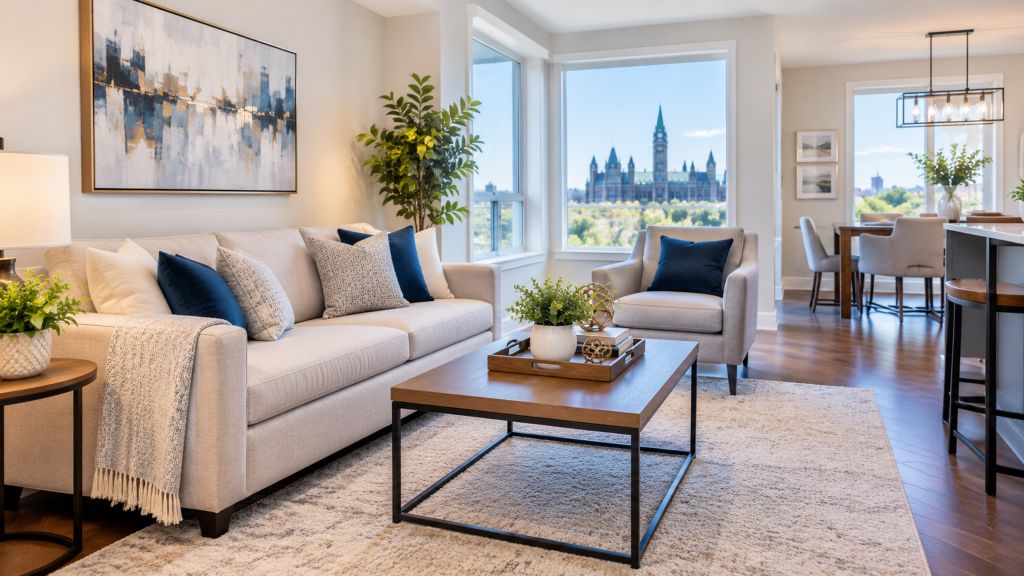
Finishes and doing it well
Colour is only half the job — finish and quality matter too. A washable eggshell or satin finish suits most walls (durable and lightly reflective); flat or matte can hide imperfections on ceilings and low-traffic walls, and semi-gloss suits trim and doors. Whatever you choose, the work has to look professional: crisp lines, full coverage, no visible roller marks or missed patches. A sloppy paint job can read worse than the old colour, because buyers register it as poor workmanship and wonder what else was done carelessly.
If you’re not confident in a clean result, this is a place where hiring it out often pays — buyers notice the difference, and photos are unforgiving of a rushed job.
How to test a colour before you commit
Because paint shifts with light, testing beats guessing. Buy sample pots and paint large swatches — at least a couple of feet square — directly on the wall, not on a card held up to it. Look at them in the morning, in the evening, and under your artificial lighting, and against your flooring and any elements that are staying. A neutral can lean pink, green, or yellow depending on the room, and only a real swatch in the real space reveals it.
Test in the rooms that matter most and let the strongest performer set the tone for the home. This small step — a few sample pots and a day of looking — prevents the expensive mistake of painting a whole house a colour that turns out cold or off once it’s up. For a home you want to sell fast, getting the neutral right the first time is worth the extra day.
The cost and payoff of repainting
Repainting is affordable relative to its impact, which is what makes it such a reliable pre-sale move. The main costs are paint, supplies, and either your time or a painter’s fee, and even hiring it out for a few key rooms is modest against the effect on how fresh the home shows. Set against the size of a typical Ottawa sale, a strategic repaint is one of the smallest line items with one of the largest effects on first impressions.
The payoff isn’t just a possible bump in price — it’s a faster sale and fewer buyers mentally deducting for work. That combination is why paint sits near the top of almost every list of worthwhile pre-sale updates.
Keep freshly painted rooms ventilated while the paint cures; Health Canada’s indoor air guidance covers the compounds fresh paint releases. Leftover paint can go back to participating retailers listed in the City of Ottawa’s Waste Explorer, and empty paint cans go in the blue bin.


Posted on Google 

Jennifer Clark
10 days ago
 Trustindex verifies that the original source of the review is Google.
His availability to communicate was incredible which is so important when selling a house. Great at everything else too.
Posted on Google

Aarushi Govil
21 days ago
Trustindex verifies that the original source of the review is Google. Working with Jason has been an absolute privilege from start to finish. Finding the right realtor can be daunting, but Jason exceeded every expectation. He is remarkably knowledgeable and was extremely punctual and responsive to every question or request we had, no matter the time or the day. What stood out most was his complete sincerity and zero-pressure approach. When we walked through houses, he was transparent, pointing out both the pros and potential red flags instead of trying to make a quick sale. His honest feedback gave us complete confidence in our decision. If you want a dedicated, honest, and highly skilled agent in your corner, look no further than Jason!
Posted on Google

Joe Ireland
35 days ago
Trustindex verifies that the original source of the review is Google. Jason helped me buy my first home.
He was extremely responsive and available from our very first call, and assisted with booking multiple viewings across Ottawa.
He was punctual to every viewing and honest with his feedback with the homes we saw, and when it came time to go from viewing to buying, he had an impressive array of contacts from brokers to inspectors to lawyers, all with excellent reviews and who were great to work with in their own right.
As a first-time home buyer, his responsiveness and patience with many questions were extremely reassuring and really streamlined the process, and I signed an offer on my home within just 2 weeks of meeting him.
I would strongly recommend Jason to anyone buying a home in Ottawa, especially to those who are strangers to the process like I was.
Thank you again, Jason!
Posted on Google

Marina
65 days ago
Trustindex verifies that the original source of the review is Google. We had a wonderful experience working with our realtor - Jason Polonski. He is a professional, knowledgeable, responsive, and truly attentive to our needs. Jason guided us through every step of the process, answered all of our questions. My family are very grateful for his work and would absolutely recommend him to anyone looking for a reliable and trustworthy realtor in Ottawa and around !
Posted on Google

Vatrul “Vatrul”
69 days ago
Trustindex verifies that the original source of the review is Google. First time home seller. Every process of the journey was explained and laid out perfectly.. Very highly recommended.. thank you Jason..
Posted on Google

Olga V.
70 days ago
Trustindex verifies that the original source of the review is Google. Jason is very knowledgeable realtor in Kanata. He’s been always good beyond to help his clients. We had a place experience buying a house in Kanata. I highly recommend him.
Posted on Google

Yuri Tsouker
77 days ago
Trustindex verifies that the original source of the review is Google. Working with Jason on the sale of my property was genuinely one of the smoothest professional experiences I've had. He was responsive at every step, patient with every question (and I had many), and he clearly knew the local market inside and out.
My sale wasn't a simple one — there was a tenant, a rental water heater, a plumber to coordinate, and plenty of complications that made this a genuinely difficult case. Jason handled all of it with calm, practical advice and always got back to me quickly, often with a solution before I even finished asking about the problem.
What stood out most was his honesty. He didn't push, he didn't overpromise, and every recommendation he made turned out to be exactly right. I felt like I had a professional in my corner from day one.
If you're looking for a realtor who is knowledgeable, responsive, and genuinely trustworthy, I can't recommend Jason highly enough. Thank you, Jason — much appreciated!
Posted on Google

Denis Pepin
101 days ago
Trustindex verifies that the original source of the review is Google. Outstanding Experience with Jason Polonski!
Last May, my wife and I sold our home in Stittsville with Jason Polonski, and we couldn't be happier with our decision. Jason made the entire process remarkably smooth and stress-free.
From day one, Jason stood out for his exceptional communication. He was always prompt and available to answer our queries—often within minutes—no matter the time of day. Whenever we had questions regarding paperwork, listing strategies, or handling property details, he addressed every concern with a truly genuine, human touch.
What impressed us most was how proactive and reassuring he was at every step. When we had to coordinate the buyout of our water heater rental, Jason handled the reimbursement seamlessly, reassuring us with, "We should have a smooth sale now. :)"—and it truly was! Even post-closing, when we needed to arrange delivery for mailbox keys or track down final funds from head office, Jason stayed on top of every detail, putting a rush on things and constantly keeping us updated.
Jason is a dedicated, attentive, and highly professional realtor who genuinely cares about his clients. It has been an absolute pleasure working with him, and we highly recommend Jason Polonski to anyone looking to buy or sell a home in the Ottawa region.
Posted on Google

Tammy Puhakka
110 days ago
Trustindex verifies that the original source of the review is Google. I highly recommend Jason Polonski, a realtor in Kanata, Ottawa. He truly went above and beyond for me. During a long weekend, he called me and, within just two hours, had an offer to purchase prepared and sent so I could secure the home I had found and fallen in love with.
Jason was professional, efficient, knowledgeable, and incredibly pleasant to work with. His rates are very reasonable, and his dedication to his clients is outstanding. If you’re looking for fast, reliable, and friendly service, I would absolutely recommend contacting him.❤️
Posted on Google

Joe Melindy
115 days ago
Trustindex verifies that the original source of the review is Google. Everything went smoothly. Jason is very good at what he does. Would highly recommend. Thanks Jason 😊
Ottawa considerations
Two local factors shape the choice. First, light: Ottawa’s long winters and lower seasonal light reward warm, light neutrals that keep interiors feeling bright rather than grey. Second, the buyer and the home: a heritage home in the Glebe, a family home in Barrhaven, and a downsizer condo each suit a slightly different neutral, though all lean warm and light.
The colour call is best made room by room with your home’s light and likely buyer in mind, which a walk-through settles quickly. For how quickly homes are selling right now, see the Ottawa Real Estate Board’s monthly market statistics.
Painting older Ottawa homes safely
Check your home’s age before sanding or scraping. Health Canada says a home built before 1960 probably contains lead-based paint, and in homes built between 1960 and 1990 the exterior paint may contain lead. That covers much of the Glebe, Westboro, Hintonburg and Alta Vista, and a good share of older Kanata and Nepean neighbourhoods.
Painting over sound paint is generally fine; sanding, scraping and heat-stripping are what create lead dust, which is most dangerous around young children. Test first or hire a painter who follows lead-safe practices, and see Health Canada’s advice on how to reduce your exposure to lead. For other things buyers’ inspectors check in pre-1990 homes, see selling an older home in Ottawa.
Paint by Ottawa home type
Builder homes in Barrhaven, Stittsville and Riverside South often have flat builder-grade paint that doesn’t wash well. Touch-ups on flat paint tend to show as patches, so repainting a full wall usually looks better than spot-fixing.
Many 1980s and 1990s Kanata and Nepean homes still have oak trim and cabinets. Painting trim a soft white is usually a strong update; painting good-condition oak cabinets is a judgment call worth talking through before listing. In heritage homes, keep original wood that’s in good shape and focus the paint on walls and ceilings.
Jason Polonski is a full-time Ottawa REALTOR® with Right at Home Realty who helps sellers choose where to paint and which neutrals work for their home’s light and buyer — seven days a week across Kanata, Stittsville, Barrhaven, Manotick, and the wider west end.
His Bachelor of Commerce from Concordia University, a double major in Marketing and Finance, keeps paint framed as a high-return update rather than an open-ended project, and his construction background means he’ll also flag where paint is hiding a condition issue rather than fixing one.
Working within the professional standards set by the Real Estate Council of Ontario and drawing on work with hundreds of Ottawa buyers and sellers, Jason makes sure your paint spend lands where it lifts the sale. If you’re deciding what to repaint before listing, a quick walk-through can tell you exactly which rooms and which tones.
His client reviews are on his Google Business Profile. Call or text Jason at (613) 601-9333 or request a free home evaluation.
Best Paint Colours to Sell Your Home (FAQs)
Soft, warm neutrals — warm whites, greiges, gentle greys, and pale earthy tones. They photograph well, make rooms feel larger and brighter, and let buyers picture their own style, which is why they consistently outperform bold or personal colours.
Warm neutrals often work better now — cool greys can read cold and slightly dated, and can feel flat in Ottawa’s lower-light rooms and long winters. Warm whites, greiges, and soft taupes tend to feel more inviting. Always test in the actual room and light.
Bold saturated colours, very dark walls that shrink rooms, dated trend colours, highly personal or themed rooms, and too many different colours across the home. These narrow appeal and give buyers a reason to plan a repaint.
Usually yes — paint is one of the highest-return, lowest-cost pre-sale updates. Be strategic: repaint the bold, dated, scuffed, or personal rooms and high-impact spaces like living areas and the kitchen, rather than the whole house.
Walls should be neutral, but colour is welcome in removable accents — pillows, art, a runner — and on the front door, where a tasteful, confident colour boosts curb appeal. Keep colour in the changeable elements; keep the walls neutral.
Yes. Eggshell or satin suits most walls; flat or matte hides imperfections on ceilings; and semi-gloss suits trim and doors. Just as important, the work must look professional — a sloppy job can read worse than the old colour.
Usually, if you paint over sound paint without sanding. Health Canada says homes built before 1960 probably contain lead-based paint, and exterior paint on homes built from 1960 to 1990 may contain lead, so test or use a lead-safe painter before sanding, scraping or stripping.
