Carp Real Estate
Moving to Carp: A Relocation Guide
What Changes When You Move to Carp
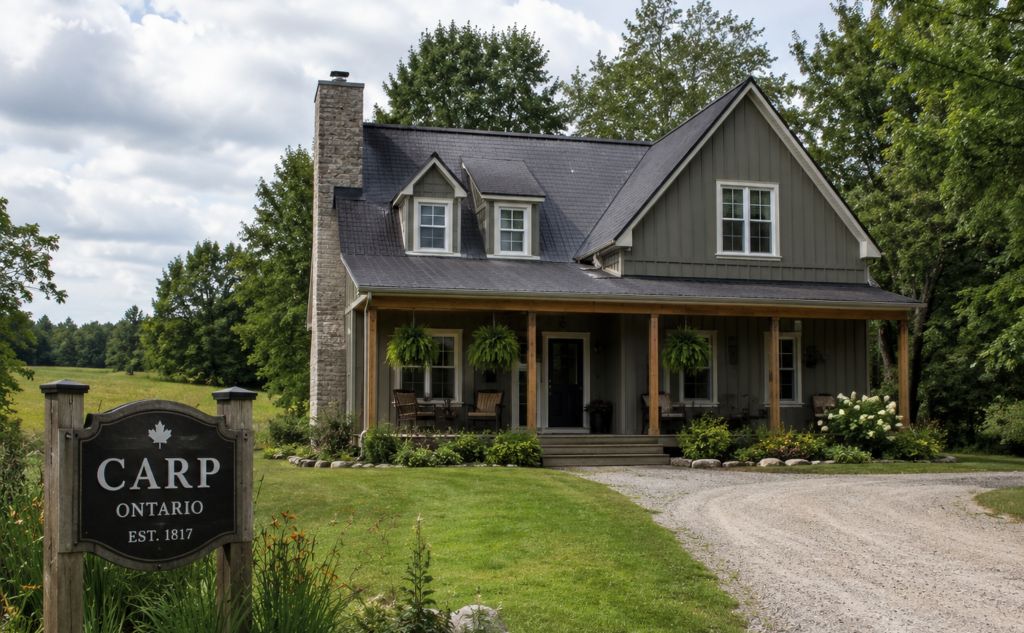
Moving to Carp means trading subdivision density for acreage, mature trees, and a village centre you can walk to in ten minutes — without giving up a manageable drive from Carp to Kanata or downtown Ottawa. Carp sits in West Carleton-March Ward, roughly 33 kilometres from downtown Ottawa, and it draws a specific kind of buyer: people who want space, a septic system instead of a strata fee, and a community small enough that the person at the farmers’ market recognizes them by the second visit. This guide covers what actually changes when you relocate here, from housing stock and closing costs to schools, commute, and day-to-day life, so you can decide whether Carp fits before you start touring homes.
New to the area? Start with the Carp, Ontario village and neighbourhood guide for an overview of the community, then use this page to plan the move itself.
By Jason Polonski, REALTOR® with Right at Home Realty in Kanata, with 15+ years of helping hundreds of buyers and sellers across Ottawa. Last updated September 2026. · Client reviews
Why People Are Moving to Carp
Most people moving to Carp are coming from Kanata, Stittsville, or elsewhere in Ottawa and want more land without leaving the region entirely. Carp attracts growing families who want a bigger yard, remote or hybrid workers who no longer need a downtown commute five days a week, and retirees looking to downsize out of a large Ottawa property into something quieter without losing proximity to hospitals and shopping. Investors and multi-generational households are also drawn to Carp’s larger rural lots, which often allow for secondary structures or expanded parking that’s harder to find on a standard urban lot.
The trade-off is pace, not access. Carp still has full grocery, banking, and pharmacy service, a strong restaurant scene for its size, and enough recreation and community programming that newcomers rarely find themselves driving into Kanata for basics. What they give up is walkable big-box shopping and frequent transit — both of which are covered below, so there are no surprises.
The buyers who tend to be happiest in Carp are the ones who genuinely want the rural lifestyle rather than tolerate it for a lower price point. That means being comfortable with a longer driveway, a well and septic system instead of municipal service, and a slower commercial strip than Kanata’s. For the right household, that trade nets out firmly in Carp’s favour.
Housing Options in Carp: What to Expect
Most of what you will find in Carp is detached — village homes on smaller lots, bungalows and two-storey homes on one to two acres, and estate or hobby-farm properties on larger acreage. Nearly all of it runs on private well and septic rather than municipal services, which is the biggest practical difference from a Kanata or Barrhaven home and something to factor into both budget and expectations. In and around the village, neighbourhoods such as Hidden Lake and Diamondview Estates offer newer homes within reach of the main street.
For newcomers, the key is matching the property to how you actually want to live: a low-maintenance village home is a very different commitment from ten acres with outbuildings. When you are ready to compare specific homes, pricing, and the rural due diligence a purchase involves, the Carp real estate guide covers property types, wells and septic, and financing in full, and you can browse current Carp listings any time.
Sell Your Ottawa Home for Just 1% Listing Commission
Why pay 2.5% listing commission to sell your home when you don't have to? Jason Polonski lists Ottawa homes for a simple 1% listing commission. Full MLS® and REALTOR.ca exposure, professional photography, powerful online marketing, expert pricing, and a skilled negotiator fighting for every dollar of your sale price. Top-tier service — you just keep thousands more when your home sells. Smart sellers are already making the switch. Your home deserves the best, and your wallet deserves a break.
What It Really Costs to Move to Carp
Beyond the purchase price, a handful of Carp-specific costs are worth budgeting for before you make an offer. Ontario’s land transfer tax applies the same way it would anywhere else in the province, though first-time buyers may qualify for a refund worth checking against Ontario’s land transfer tax refund program before closing. Rural-specific costs — well testing, septic inspection, and sometimes a WETT inspection if the home has a wood stove — are additional line items that a home in a fully serviced Kanata subdivision wouldn’t carry. For the ongoing monthly and yearly costs, from well and septic upkeep to heating and driving, see the cost of living in Carp.
| Cost Item | What to Know |
|---|---|
| Ontario land transfer tax | Standard provincial rate; first-time buyers may qualify for a partial refund |
| Well water test | Recommended before closing to confirm potability and supply |
| Septic inspection | Standard condition on rural offers; covers tank condition and leach bed function |
| Utility hookups | Hydro, propane or oil (many rural homes aren’t on natural gas), and internet setup |
| Home insurance | Rural policies can price differently based on well/septic, distance to fire hall, and heating type |
Utility setup is another area where Carp differs from serviced Ottawa neighbourhoods. Electricity is supplied through Hydro Ottawa, but not every Carp property has natural gas service, so heating type (propane, oil, or electric) is worth confirming early since it affects both monthly costs and insurance. Buyers financing a move should also revisit their budget against current lending requirements through the Financial Consumer Agency of Canada’s mortgage resources, since qualifying rates and required deposits can shift a purchase timeline.
Get Cash Back When You Buy a Home in Ottawa
Can you get cash back when buying a home in Ottawa? Yes. Jason Polonski, a Chairman's Club REALTOR® serving Ottawa and Kanata, shares part of his commission with buyers — up to $3,000 cash back at closing.* You still get full-service, award-winning representation: expert pricing, sharp negotiation, and hands-on guidance from first showing to keys in hand. No cut corners and no rebate-only shortcuts — just real money back in your pocket when you buy your Ottawa or Kanata home.
Commuting From Carp to Kanata and Downtown Ottawa
Carp is closer to the city than its rural feel suggests. The drive to downtown Ottawa is roughly 35 to 45 minutes outside rush hour via Highway 417, and Kanata’s shops, schools, and employment corridor along March Road are about 15 to 20 minutes away. That short hop to Kanata is one of the biggest reasons Carp works for people who want rural living without an unreasonable commute.
Public transit is the one area where expectations need adjusting. Carp has limited local bus service connecting to Kanata rather than frequent direct routes, so most residents rely on a personal vehicle for work, school runs, and errands. Carpooling and cycling are realistic supplements in the warmer months, but Ottawa’s winter weather makes a car the practical default for most of the year.
Winter driving is worth planning for specifically. Rural roads around Carp are maintained, but can see more accumulation and slower plowing priority than arterial roads inside Kanata, so buyers moving from a fully urban commute should budget extra time after snowfall and consider winter tires close to essential rather than optional.

Schools and Family Life in Carp
Carp falls within the Ottawa-Carleton District School Board, which operates the area’s public elementary and secondary schools and offers French immersion options for families who want them. Families moving from denser parts of Ottawa often notice smaller school populations and a closer-knit parent community, which some families prefer, and others weigh against fewer program options than a large urban school might offer. It’s worth confirming current boundary assignments directly with the school board before finalizing a purchase, since catchment areas can shift.
Beyond the classroom, Carp’s slower pace and strong sense of community tend to appeal to families with young kids and to retirees at the other end of the spectrum, giving the town an intergenerational feel that’s less common in newer subdivisions.
Extracurricular life leans on the same community infrastructure that makes Carp distinctive: arena ice time, fairground events, and 4-H style agricultural programs that simply don’t exist in the same form inside Kanata or Barrhaven. Families relocating from a denser part of Ottawa should expect a shorter drive to school pickup but a longer one to specialty tutoring, competitive sports clubs, or big-box shopping tied to school supplies.
Community, Culture, and Things to Do in Carp
Part of what makes moving to Carp appealing is that the village has a genuine social life of its own. Saturday mornings from spring through fall centre on the Carp Farmers’ Market; autumn brings the Carp Fair, one of Ontario’s oldest agricultural fairs; and the Diefenbunker museum draws visitors year-round. New residents tend to settle in fastest by turning up to a few of these — the market, the fair, minor sports, and school events.
For a fuller picture of the community, its history, and what daily life is actually like before you commit, the Carp neighbourhood guide walks through it in detail.

Working With a Realtor Who Knows Carp
Jason Polonski is a REALTOR® with Right at Home Realty who works Ottawa’s west end, including Carp, Kanata, and Stittsville, on a day-to-day basis rather than as an occasional referral area. Before real estate, Jason spent years in construction and holds a technical diploma in Construction Electricity, on top of a Bachelor of Commerce in Marketing and Finance from Concordia University — a background that matters directly when a Carp property comes with a well, a septic system, or an older electrical panel that needs a second, informed look. He’s available seven days a week and has spent 15-plus years helping buyers and sellers move through exactly these kinds of decisions.
For anyone relocating to Carp, Jason can walk through current inventory, realistic price ranges, and what a specific property’s servicing and lot actually mean day to day; for anyone leaving a Carp property behind, his guide to selling a home in Carp covers what local sellers should expect from pricing to closing. Buyers and sellers working through a simultaneous move can reach him directly through his Carp REALTOR® page to start with a straightforward conversation about timing before anything goes on the market.
Related guides: Carp vs Kanata · Carp estate subdivisions · Huntley Hollow bungalow rentals in Carp

Posted on Google 

Jennifer Clark
13 days ago
 Trustindex verifies that the original source of the review is Google.
His availability to communicate was incredible which is so important when selling a house. Great at everything else too.
Posted on Google

Aarushi Govil
24 days ago
Trustindex verifies that the original source of the review is Google. Working with Jason has been an absolute privilege from start to finish. Finding the right realtor can be daunting, but Jason exceeded every expectation. He is remarkably knowledgeable and was extremely punctual and responsive to every question or request we had, no matter the time or the day. What stood out most was his complete sincerity and zero-pressure approach. When we walked through houses, he was transparent, pointing out both the pros and potential red flags instead of trying to make a quick sale. His honest feedback gave us complete confidence in our decision. If you want a dedicated, honest, and highly skilled agent in your corner, look no further than Jason!
Posted on Google

Joe Ireland
38 days ago
Trustindex verifies that the original source of the review is Google. Jason helped me buy my first home.
He was extremely responsive and available from our very first call, and assisted with booking multiple viewings across Ottawa.
He was punctual to every viewing and honest with his feedback with the homes we saw, and when it came time to go from viewing to buying, he had an impressive array of contacts from brokers to inspectors to lawyers, all with excellent reviews and who were great to work with in their own right.
As a first-time home buyer, his responsiveness and patience with many questions were extremely reassuring and really streamlined the process, and I signed an offer on my home within just 2 weeks of meeting him.
I would strongly recommend Jason to anyone buying a home in Ottawa, especially to those who are strangers to the process like I was.
Thank you again, Jason!
Posted on Google

Marina
68 days ago
Trustindex verifies that the original source of the review is Google. We had a wonderful experience working with our realtor - Jason Polonski. He is a professional, knowledgeable, responsive, and truly attentive to our needs. Jason guided us through every step of the process, answered all of our questions. My family are very grateful for his work and would absolutely recommend him to anyone looking for a reliable and trustworthy realtor in Ottawa and around !
Posted on Google

Vatrul “Vatrul”
72 days ago
Trustindex verifies that the original source of the review is Google. First time home seller. Every process of the journey was explained and laid out perfectly.. Very highly recommended.. thank you Jason..
Posted on Google

Olga V.
73 days ago
Trustindex verifies that the original source of the review is Google. Jason is very knowledgeable realtor in Kanata. He’s been always good beyond to help his clients. We had a place experience buying a house in Kanata. I highly recommend him.
Posted on Google

Yuri Tsouker
80 days ago
Trustindex verifies that the original source of the review is Google. Working with Jason on the sale of my property was genuinely one of the smoothest professional experiences I've had. He was responsive at every step, patient with every question (and I had many), and he clearly knew the local market inside and out.
My sale wasn't a simple one — there was a tenant, a rental water heater, a plumber to coordinate, and plenty of complications that made this a genuinely difficult case. Jason handled all of it with calm, practical advice and always got back to me quickly, often with a solution before I even finished asking about the problem.
What stood out most was his honesty. He didn't push, he didn't overpromise, and every recommendation he made turned out to be exactly right. I felt like I had a professional in my corner from day one.
If you're looking for a realtor who is knowledgeable, responsive, and genuinely trustworthy, I can't recommend Jason highly enough. Thank you, Jason — much appreciated!
Posted on Google

Denis Pepin
104 days ago
Trustindex verifies that the original source of the review is Google. Outstanding Experience with Jason Polonski!
Last May, my wife and I sold our home in Stittsville with Jason Polonski, and we couldn't be happier with our decision. Jason made the entire process remarkably smooth and stress-free.
From day one, Jason stood out for his exceptional communication. He was always prompt and available to answer our queries—often within minutes—no matter the time of day. Whenever we had questions regarding paperwork, listing strategies, or handling property details, he addressed every concern with a truly genuine, human touch.
What impressed us most was how proactive and reassuring he was at every step. When we had to coordinate the buyout of our water heater rental, Jason handled the reimbursement seamlessly, reassuring us with, "We should have a smooth sale now. :)"—and it truly was! Even post-closing, when we needed to arrange delivery for mailbox keys or track down final funds from head office, Jason stayed on top of every detail, putting a rush on things and constantly keeping us updated.
Jason is a dedicated, attentive, and highly professional realtor who genuinely cares about his clients. It has been an absolute pleasure working with him, and we highly recommend Jason Polonski to anyone looking to buy or sell a home in the Ottawa region.
Posted on Google

Tammy Puhakka
113 days ago
Trustindex verifies that the original source of the review is Google. I highly recommend Jason Polonski, a realtor in Kanata, Ottawa. He truly went above and beyond for me. During a long weekend, he called me and, within just two hours, had an offer to purchase prepared and sent so I could secure the home I had found and fallen in love with.
Jason was professional, efficient, knowledgeable, and incredibly pleasant to work with. His rates are very reasonable, and his dedication to his clients is outstanding. If you’re looking for fast, reliable, and friendly service, I would absolutely recommend contacting him.❤️
Posted on Google

Joe Melindy
118 days ago
Trustindex verifies that the original source of the review is Google. Everything went smoothly. Jason is very good at what he does. Would highly recommend. Thanks Jason 😊
Moving to Carp (FAQs)
Carp suits families who want more space, a slower pace, and a genuine small-town feel while staying close enough to Kanata and downtown Ottawa for work and school runs. It’s a strong fit for growing families, remote or hybrid workers, and retirees downsizing out of a larger property, though buyers who need walkable big-box shopping or frequent transit tend to be happier in a more urbanized part of West Ottawa.
Carp is about 33 kilometres from downtown Ottawa, roughly 35 to 45 minutes outside rush hour via Highway 417. Kanata’s shops, schools, and employment corridor along March Road are closer still, about a 15- to 20-minute drive from Carp.
Most properties in Carp run on a private well and septic system rather than municipal water and sewer service. Buyers should budget for a well water test and a professional septic inspection as conditions of their offer, since these systems affect both the home’s condition and its insurance costs.
It’s possible, but limiting. Carp has a local bus service connecting to Kanata rather than frequent direct routes, so most residents rely on a personal vehicle for work, errands, and school pickup, with carpooling or cycling as seasonal supplements rather than a full replacement.
Carp falls within the Ottawa-Carleton District School Board, which operates the area’s public elementary and secondary schools and offers French immersion for families who want it. Because catchment boundaries can shift, buyers should confirm the specific school assignment for a property before finalizing a purchase.
Yes. On top of Ontario’s standard land transfer tax, rural purchases in Carp typically add a well water test, a septic inspection, and sometimes a WETT inspection if the home has a wood stove — costs that a fully serviced Kanata or Stittsville home wouldn’t carry. A local REALTOR® with hands-on trades experience, like Jason Polonski, can help flag which of these conditions actually matter for a specific property before an offer goes in.
Spring and early fall tend to bring the most listing activity in Carp, giving buyers the widest selection to compare lot size, servicing, and condition. Moving in late fall or winter is workable but means factoring in snow-covered driveways, less daylight for showings, and slower rural road plowing when planning the move itself.
Rural roads around Carp are maintained but generally see slower plowing priority than arterial roads inside Kanata, so extra travel time after snowfall is normal. A reliable vehicle and winter tires are close to essential for anyone commuting from Carp through the winter months.
