Home Office Ideas That Boost Productivity and Motivation
Home Office Ideas That Boost Productivity and Motivation
Working from home has become a permanent fixture of life in Ottawa, Kanata, Stittsville, and the surrounding communities. According to Statistics Canada Labour Force Survey data, Ottawa-Gatineau leads the country in remote work adoption, with over one-third of employed residents working mostly from home. That shift has changed what buyers and homeowners expect from their living spaces — and it makes a thoughtfully designed home office one of the most valuable investments you can make in your property. Whether you are carving out a corner of a spare bedroom or converting an entire room, the right setup has a direct impact on how well you work, how long you sustain focus, and how your home functions for years to come.
Why Your Home Office Setup Matters More Than You Think
A makeshift arrangement on the kitchen table was acceptable as a temporary measure. For the long term, it creates real problems. Poor ergonomics lead to physical strain. Noise and interruptions destroy concentration. The absence of visual separation between work and home life makes it difficult to mentally switch off at the end of the day.
The Ontario government’s computer ergonomics guidelines, developed under the Occupational Health and Safety Act, make clear that employers have legal obligations to support safe workstation design — a standard that applies just as meaningfully to a home workspace. The same principles that protect workers in commercial offices apply at your dining room table, whether your employer acknowledges it or not.
For Ottawa-area homeowners, there is also a practical financial dimension. A well-executed home office is an increasingly sought-after feature in the local real estate market. Homes in Kanata, Kanata Lakes, and Stittsville regularly list dedicated home offices as a key selling point, and buyers working in the tech sector — a major employment base in the city’s west end — actively search for properties that support remote work.
Ottawa Real Estate Promotions
Choosing the Right Space in Your Home
The first decision is location. Not every room makes an equally effective workspace, and the choice you make will shape everything that follows.
Prioritize Natural Light and Quiet
Natural light is one of the most powerful tools for sustained focus and energy regulation. Wherever possible, position your desk perpendicular to a window rather than directly facing it or placing it at your back. This reduces screen glare while still allowing daylight into your peripheral field of view.
Rooms that face away from street noise and household traffic are worth a premium in a home office context. In many Ottawa homes — particularly in Kanata’s established neighbourhoods like Beaverbrook and Katimavik, or in Stittsville’s newer subdivisions — there is often a room at the back of the house or on an upper floor that offers both quiet and natural light. That combination is where a home office thrives.
Dedicated Space vs. Shared Space
A dedicated room is always preferable to a shared space. Closing a door at the end of the workday creates a physical and psychological boundary that helps you disengage from work. It also gives you a room that can be styled and equipped purely for productivity.
That said, shared spaces can work with smart design. A built-in desk alcove in a bedroom, or a purposefully designed corner in a finished basement, can function well if the layout creates visual separation and the acoustic environment is managed.
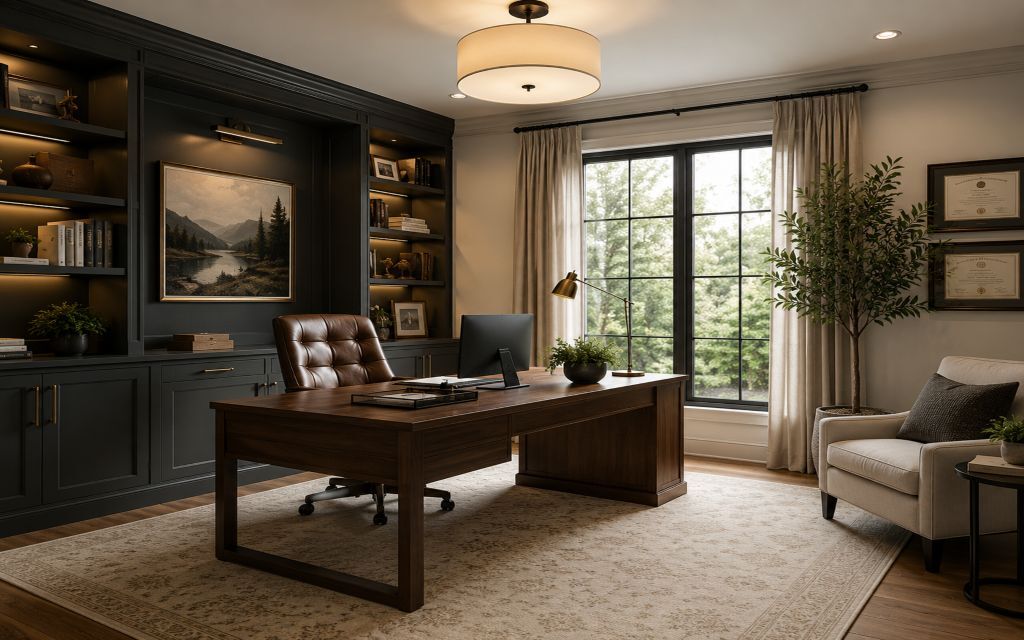
Essential Home Office Ideas for a Productive Setup
Once you have identified your space, the design decisions become more specific. These are the elements that make the largest difference.
Invest in an Ergonomic Chair and Adjustable Desk
This is the single most impactful purchase you can make. A properly adjusted chair with lumbar support, adjustable armrests, and a seat height that allows your feet to rest flat on the floor is the foundation of an ergonomic workspace. The Association of Canadian Ergonomists emphasizes that workstation design should fit the individual — not the other way around. An ill-fitting chair is not just uncomfortable; it contributes to musculoskeletal injuries that compound over months and years.
A height-adjustable standing desk is worth the investment for anyone spending six or more hours per day at a workstation. Alternating between sitting and standing throughout the day reduces fatigue, supports circulation, and helps maintain focus during long work sessions.
Manage Lighting with Intention
Overhead lighting alone is rarely sufficient for a functional home office. It creates harsh shadows and often produces glare on screens. Layer your lighting instead: a warm ambient source overhead, a task lamp with adjustable colour temperature on your desk, and bias lighting behind your monitor to reduce eye strain during video calls and screen work.
In winter months — which run long in the Ottawa Valley — natural light is limited during morning and evening hours. A daylight-spectrum lamp rated at 5,000 to 6,500 Kelvin can compensate effectively during those darker periods without requiring a full renovation.
Prioritize Acoustic Control
Sound management is underestimated in most home office setups. Conversations from other rooms, street traffic, and the sounds of a household in motion are significant cognitive disruptors. Soft furnishings — a rug, curtains, upholstered seating — absorb sound effectively. A solid-core interior door makes a meaningful difference compared to a hollow-core alternative. If you are in a finished basement, acoustic ceiling tiles or panels can dramatically reduce sound transmission from the floor above.
For video calls, a USB microphone or a headset with noise cancellation is a practical investment that improves both your experience and the experience of everyone you speak with professionally.
Cable Management and Technology Infrastructure
A chaotic desk surface creates cognitive noise. Invest in a cable management system — desk grommets, adhesive cable clips, or a simple cable box — to keep power cords and peripherals organized. A monitor arm frees up substantial desk real estate and allows you to adjust screen height and distance precisely.
Your internet connection deserves equal attention. If your home office is far from your router, a Wi-Fi access point or a powerline adapter can provide the stable, high-speed connection that video calls and cloud-based work demand. In Kanata and Stittsville, fibre-to-the-home services are widely available, and ensuring your in-home network matches the speed of your internet plan is worth confirming with your provider.
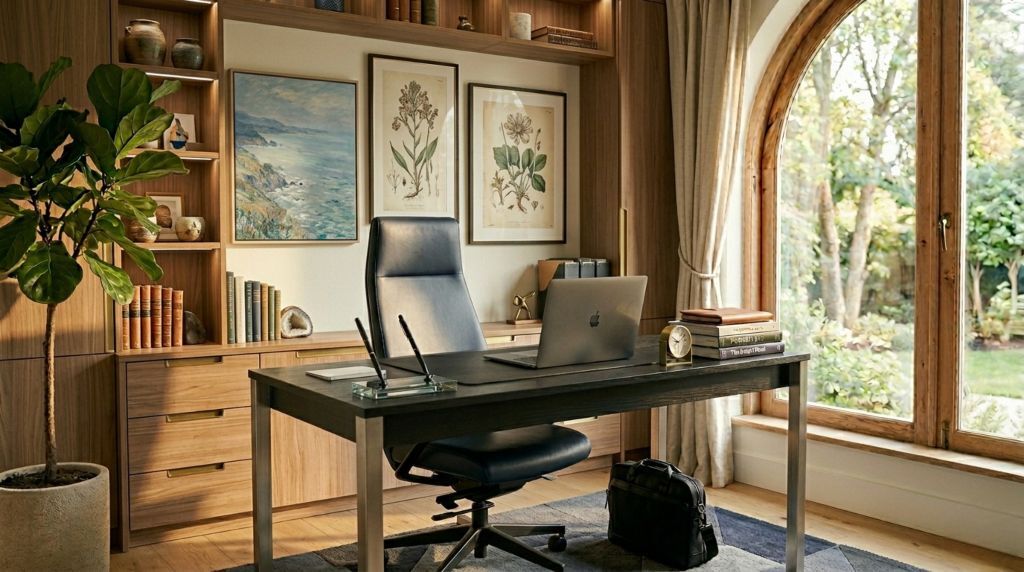
Designing for Motivation, Not Just Function
Productivity is not purely mechanical. The visual and sensory environment of your workspace affects mood, energy levels, and creative output in ways that are well-documented in occupational health research.
Use Colour Strategically
Colour psychology research consistently finds that blue tones support focus and analytical work, while warmer greens promote calm and reduce stress. White walls with natural wood accents create a clean, energising environment without visual clutter. Whatever palette you choose, consistency matters — a visually chaotic space works against sustained concentration.
Bring Nature Indoors
Biophilic design — incorporating natural materials, plants, and views of the outdoors — has measurable effects on workplace wellbeing. A small collection of low-maintenance plants, such as pothos, snake plants, or peace lilies, introduces organic form and colour without requiring significant upkeep. Studies from leading environmental psychology research have linked access to green elements in a workspace with reduced stress and improved recovery from mentally demanding tasks.
Create a Visual Boundary Between Work and Home
In a shared space especially, a visual anchor that signals “this is the office” matters for your own psychology. A dedicated desk, a distinctive area rug, or even a specific piece of artwork hung only in that zone helps your brain associate the space with focused work — and, importantly, helps it disengage when you physically leave the area.
Ottawa Real Estate Services
Home Office Costs and Tax Considerations in Canada
Setting up a home office involves real costs, and Canadian tax law recognises this. Employees who worked from home for more than 50 percent of their hours for at least four consecutive weeks during the year may be eligible to claim a portion of home office expenses. The Canada Revenue Agency’s Guide T4044 outlines what qualifies under the detailed method, which is the only method available for the 2024 and 2025 tax years following the discontinuation of the pandemic-era flat-rate approach.
Eligible expenses can include a proportionate share of rent or mortgage interest, utilities, internet, and home maintenance costs. Employees require a completed T2200 form from their employer to claim these deductions. Self-employed individuals have broader latitude and can claim expenses through their T2125.
| Expense Category | Employee Eligibility | Self-Employed Eligibility |
|---|---|---|
| Utilities (heat, electricity) | Proportionate share | Proportionate share |
| Internet | Yes | Yes |
| Rent / mortgage interest | Proportionate share | Proportionate share |
| Office furniture | Generally no | Yes (capital cost allowance) |
| Maintenance and repairs | Proportionate share | Proportionate share |
Before making significant home office investments, consulting with a Canadian tax professional about what qualifies for your specific employment arrangement is always worthwhile.
The Real Estate Value of a Well-Designed Home Office
From a market perspective, a dedicated and properly finished home office adds demonstrable appeal to a property in Ottawa’s current buyer landscape. Listings across Kanata, Kanata Lakes, Nepean, and Barrhaven consistently highlight home offices as key features, and buyers — particularly those employed in the region’s federal government and technology sectors — prioritize homes that eliminate the need for a separate lease on co-working space.
This does not mean building the most elaborate setup imaginable before listing. It means ensuring that the space is clean, clearly functional, and wired appropriately. A spare bedroom that has been thoughtfully converted — with a hardwired internet drop, adequate lighting, a proper window, and a neutral finish — will photograph and show far better than a room that has been treated as storage overflow with a folding table pushed into one corner.
Working with buyers across Kanata, Stittsville, Barrhaven, and Manotick over many years, Jason Polonski has seen demand for home office functionality shift from a secondary consideration to a primary search filter for a meaningful portion of buyers. The Ottawa Real Estate Board tracks buyer feature preferences across the Ottawa market, and the data consistently reflects the post-pandemic recalibration of what a functional home looks like. A property that delivers on this expectation is better positioned for a faster sale at a stronger price.
Ottawa Real Estate Tools
Practical Home Office Setup Checklist for Ottawa Homeowners
Before finalizing your setup — whether for personal productivity or in preparation for selling — walk through these fundamentals:
Space and Layout: Choose a room with natural light and manageable noise levels. Ensure there is enough square footage to accommodate a proper desk, chair, and at least one storage solution. Avoid positioning your primary desk with a window directly behind it during video calls, as backlighting washes out your image.
Furniture and Ergonomics: Invest in a height-adjustable chair with lumbar support. A monitor at eye level prevents neck strain. Your keyboard and mouse should allow your forearms to remain parallel to the floor with wrists in a neutral position, consistent with guidance from the Canadian Standards Association’s office ergonomics standard Z412.
Technolog:y Verify your internet speed and signal strength at the desk location before committing to the room. Install adequate power outlets — ideally through an electrician — rather than relying on extension cords. A surge protector with USB charging ports is a practical and inexpensive addition.
Aesthetics and Wellbeing Layer your lighting, introduce at least one plant, and apply a neutral but intentional wall colour. Keep the desk surface clear of anything unrelated to work. A tidy, purposeful environment reinforces the mindset needed to do your best work — and presents exceptionally well if and when you choose to sell.

A home office is no longer a luxury addition to a property. In Ottawa, Kanata, Stittsville, and across the region, it has become a functional requirement for a large proportion of the working population. Approaching the design with the same care you would apply to a kitchen or master suite renovation — with attention to ergonomics, technology, light, and finish — produces a space that serves you well every day and strengthens the long-term value of your home.
If you are considering a home purchase with dedicated office space in mind, or preparing a property for sale and want honest guidance on how buyers in the current market are evaluating workspace functionality, contact Jason Polonski at (613) 601-9333 to connect with an experienced Ottawa REALTOR® who understands what today’s buyers are looking for.
Home Office Ideas (FAQs)
The single most impactful element is ergonomics — specifically your chair and desk setup. A chair with proper lumbar support, adjustable armrests, and a seat height that keeps your feet flat on the floor reduces physical strain and allows you to work comfortably for extended periods. Pair that with a monitor positioned at eye level and a desk at the correct height for your forearms, and you have the foundation that everything else builds on. Lighting, acoustics, and aesthetics all matter, but no amount of décor compensates for a setup that causes pain.
Yes, if you meet the Canada Revenue Agency’s eligibility criteria. For the 2024 and 2025 tax years, employees must use the detailed method, which requires a completed T2200 form signed by their employer confirming they worked from home more than 50 percent of the time for at least four consecutive weeks. Eligible expenses include a proportionate share of utilities, rent or mortgage interest, and internet costs. Self-employed individuals have broader options and can claim expenses through Form T2125. The flat-rate pandemic method is no longer available. Consult a Canadian tax professional to confirm what applies to your specific situation.
A well-finished, functional home office is increasingly valued by buyers in Ottawa, Kanata, Stittsville, and surrounding communities — particularly those working in the region’s technology and federal government sectors. A room that is properly lit, wired for high-speed internet, and finished to a neutral standard shows significantly better than a converted storage room with a folding table. While a home office alone rarely drives a dramatic price premium, it broadens buyer appeal, reduces days on market, and is now a standard search filter for a meaningful share of Ottawa-area buyers.
A functional home office can be created in as little as 80 to 100 square feet — roughly the size of a small bedroom. That is enough room for a full-size desk, an ergonomic chair, a filing cabinet or shelving unit, and comfortable movement around the space. What matters more than total square footage is the quality of the space: natural light, a door that closes, a strong internet signal, and adequate electrical outlets. Many Ottawa homeowners convert a spare bedroom, a finished basement room, or a large landing area into highly effective workspaces without a single structural change.
Layered lighting outperforms any single fixture. Start with ambient overhead lighting to eliminate dark corners, then add a task lamp on your desk with adjustable colour temperature — warm for focused writing and reading, cooler for analytical or screen-heavy work. Position your primary light source to the side of your monitor rather than directly behind or in front of the screen to reduce glare. During Ottawa’s long winter months, a daylight-spectrum lamp rated between 5,000 and 6,500 Kelvin can compensate for reduced natural light and help maintain energy and alertness during morning and evening working hours.
Soft furnishings are your most accessible tool. An area rug, thick curtains, and upholstered furniture absorb sound that hard surfaces reflect. A solid-core interior door makes a more noticeable acoustic difference than most homeowners expect. For sound coming from above — common in homes with finished basements used as offices — acoustic ceiling panels or even a coffered ceiling treatment can reduce transmission significantly. For your end-of-video calls, a USB condenser microphone or a headset with active noise cancellation removes background sound at the source, which is often the most practical and immediate solution.
Prioritize a room that is separated from the main living area, has at least one window, and sits away from high-traffic zones like the kitchen or living room. Confirm that the room has sufficient electrical outlets and check the internet signal strength at that location before committing — especially in larger homes where the router may be on the opposite end of the floor plan. In Kanata and Stittsville, many newer builds include a main-floor den or a finished basement room that functions naturally as a home office. Older homes in established neighbourhoods like Beaverbrook or Bridlewood often have a fourth bedroom or bonus room that converts well. A local REALTOR® familiar with the area can help you identify listings where the layout genuinely supports a functional workspace.
Both can work well — the right choice depends on your specific home and how you work. A basement office offers strong acoustic separation from household activity and is often the coolest and quietest part of the home in summer. The trade-off is natural light, which is typically limited to small windows or none at all. An upper-floor office, particularly a room at the back of the house, often provides better light and a quieter view while still being removed from main-floor noise. If your work involves frequent video calls, natural light from a window positioned to the side of the camera rather than behind you is a significant advantage worth prioritizing over acoustic comfort alone.